
The regulatory environment in India has undergone significant change. Because of rapid digitization, the move to cloud computing, greater inspection by organizations such as the Reserve Bank of India (RBI) and the Securities and Exchange Board of India (SEBI), and the implementation of the Digital Personal Data Protection (DPDP) Act, the days of relying on ad hoc and spreadsheet-based compliance are over.
It is no longer feasible for today's compliance officers to use manual trackers, shared folders, and a collection of isolated solutions. Under the DPDP Act, a breach of data privacy could result in fines of up to ₹250 crore, and regulatory audits conducted by financial watchdogs require verifiable, real-time evidence of the controls in place.
Modern Governance, Risk, and Compliance (GRC) platforms have now been introduced. Should you be looking for the best GRC software in India, your organization will need a platform that goes beyond generic global checklist templates to address India's complex statutory requirements while also meeting international standards such as SOC 2 and ISO 27001.
KavachOne has become the leading GRC and compliance automation ecosystem in India. Let us examine what constitutes a first-rate GRC tool and how KavachOne enables Indian companies to achieve audit-ready resilience.
What Is GRC Software and Why Is It Critical for Indian Enterprises?
Governance, Risk, and Compliance (GRC) software is a technological platform that centralizes functions and helps organizations align their IT and business strategies with legal requirements, assess and reduce operational risks, and maintain continuous regulatory compliance.
A modern GRC platform integrates three critical operational pillars:
Governance involves handling the company's internal policies, operational workflows, and executive oversight to ensure the corporation's actions align with ethical standards and strategic objectives.
Risk management involves identifying, assessing, rating, and reducing technical, legal, operational, and third-party risks before they cause financial loss or reputational damage.
Compliance involves adhering to industry benchmarks, contractual agreements, and government requirements, such as the RBI Master Directions, the CERT-In cybersecurity directives, the SEBI cybersecurity frameworks, and the ISO standards.
For Indian companies, managing these three areas in separate operational silos leads to redundant work, failure to identify appropriate policies, human error, and lengthy audit cycles. Using unified GRC software enables compliance to shift from a frantic annual effort to a continuous, automated background process.
Key Challenges with Traditional Compliance Approaches
A great many organizations try to keep compliant by using simple project management software, spreadsheets, and scattered email conversations. This traditional method results in serious bottlenecks:
There is regulatory fragmentation since Indian companies have to deal with overlapping requirements set out by local regulations (the DPDP Act, the RBI's cyber directives, CERT-In's requirements) as well as by international export standards (SOC 2, ISO 27001, HIPAA, PCI DSS, GDPR). The time and effort that engineers and security personnel spend mapping the same security control for five separate audits is considerable.
Spreadsheets have the disadvantages of not providing version control, lacking continuous automated monitoring, and being unable to demonstrate, at the time of an incident, whether a control was actually operating.
When companies outsource functions such as infrastructure, software development, and customer operations, suppliers become the primary means through which attacks are carried out. Annual vendor surveys cannot keep pace with changes in their security positions in real time.
The problem with audit fatigue is that it takes weeks to collect the evidence needed for an audit, requiring extensive work to locate screenshots, system logs, configuration files, and HR approvals. This kind of manual effort wastes a lot of productive time and strains internal teams.
Essential Features to Look for in the Best GRC Software in India
When looking for the best GRC software in India, security and legal leaders should evaluate tools using the following key technical criteria:
Evaluation Criteria | Legacy GRC Point Solutions | Modern Indian GRC Platforms |
Local Regulatory Alignment | Generic, western-centric frameworks; slow to support Indian laws. | Built-in support for the DPDP Act, RBI directives, SEBI, and CERT-In. |
Audit Preparation Speed | Requires manual evidence collection over months. | Continuous automated evidence collection; audit-ready in weeks. |
Risk Assessment Engine | Static risk heat maps updated once a quarter. | AI-assisted risk engines with automated threat and vulnerability tracking. |
Data Privacy & Consent | Requires separate third-party consent plugins. | Integrated multilingual consent, PII discovery, and DSAR workflows. |
Auditor Ecosystem | Software-only; you must find and pay external auditors. | Integrated software plus accredited auditors (e.g., PCI QSA, CPA-led). |
Why KavachOne Stands Out as India’s Leading GRC Platform
KavachOne bridges the gap between automated software workflows and deep regulatory expertise by offering a comprehensive GRC system that accounts for the specific operational and legal contexts faced by companies in India.
As an accredited PCI DSS Qualified Security Assessor (QSA) company, and with support from experienced cybersecurity and legal leaders, KavachOne provides software developed by professionals with a strong understanding of how audits work in practice.
KavachOne simplifies and strengthens enterprise compliance through several core capabilities:
ComplyXpert: The Unified Engine for Compliance Management
ComplyXpert, KavachOne's flagship Compliance Management System, forms the core of the platform and brings together, in a single center, compliance documentation, policy management, and workflow automation.
30+ Supported Standards: Maps controls across the DPDP Act, ISO 27001, SOC 2, HIPAA, PCI DSS, RBI IT Framework, SEBI Cybersecurity Guidelines, and GDPR.
Control Cross-Mapping: Write and verify a security control once (e.g., multi-factor authentication or role-based access control), and ComplyXpert maps it across all relevant standards, eliminating duplicate effort.
Customizable Workflows: Adapt internal processes to your specific corporate structure rather than forcing operations into rigid, off-the-shelf templates.
Time-Stamped Audit Trails: Maintains tamper-evident audit logs of control updates, policy acknowledgments, and operational reviews, keeping your organization continuously audit-ready.
2. Suite for Complying with the Native DPDP Act
Most global GRC platforms treat data privacy as an afterthought, relying on generic GDPR frameworks. KavachOne features a dedicated, native DPDP compliance suite built for the Indian legal ecosystem:
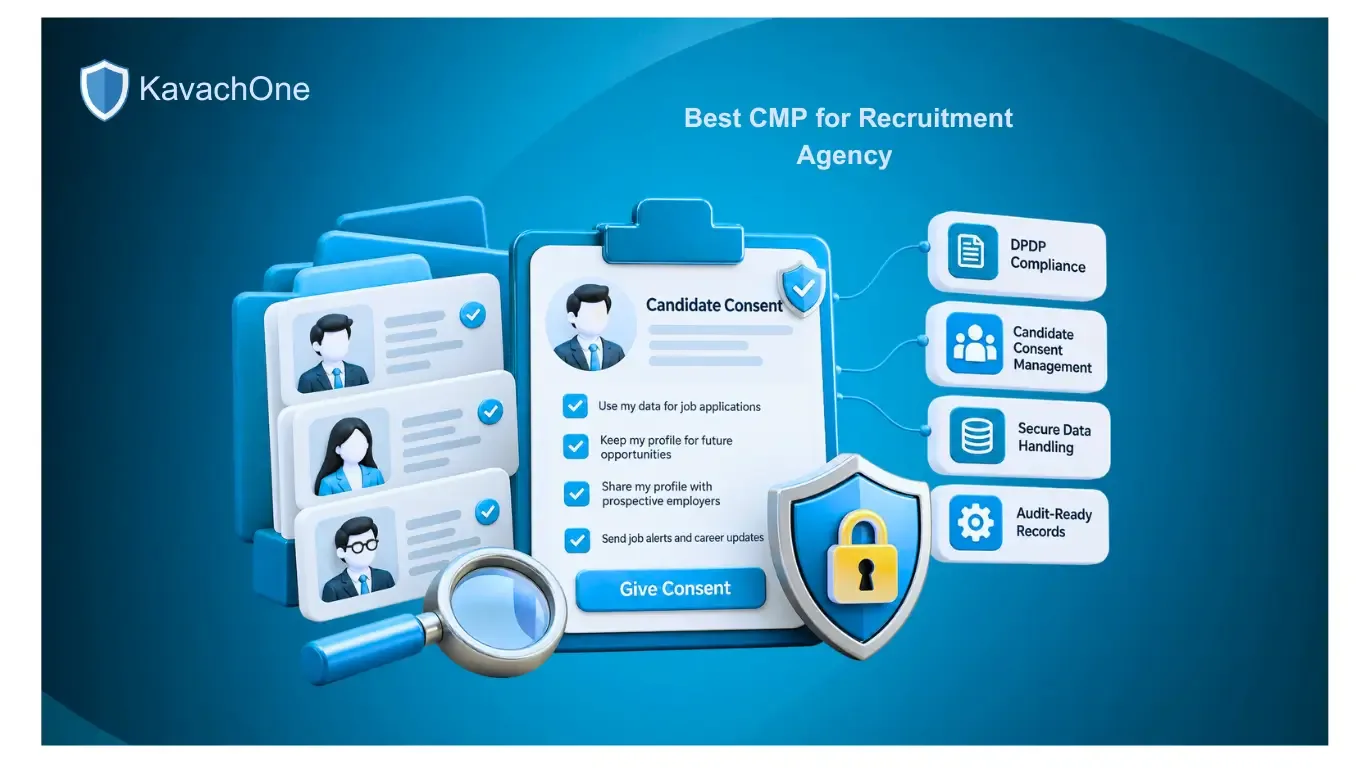
ConsentiQo (Consent Management Platform): Captures, updates, and manages granular, purpose-specific consent across web platforms, mobile applications, APIs, and offline interactions. It supports notice delivery across 22 scheduled Indian languages to meet statutory obligations.
PII Discovery & Scanning: Automated scanners crawl on-premise servers, cloud databases, file stores, and microservices to locate and classify sensitive personal data, giving you real-time visibility over your data estate.
Data Principal Rights Automation (DSAR/DSR): Automatically validates, processes, and tracks access, correction, and erasure requests from users within mandated statutory timelines.
DPIA Automation Suite: Streamlines Data Protection Impact Assessments (DPIAs) with prebuilt risk-evaluation workflows tailored to high-risk processing activities.
3. Integration of Third-Party Risk Management (TPRM)
A company's security perimeter extends to its supply chain. KavachOne’s integrated TPRM engine automates vendor due diligence, risk classification, and ongoing assessment:
Automated Screening & Risk Profiling: Replaces manual email questionnaires with automated vendor risk assessments and Customer Due Diligence (CDD) scanners.
Shadow IT & Cloud App Detection: Uncovers unsanctioned software, APIs, and cloud applications that increase data leak risks across enterprise departments.
Continuous Vendor Auditing: Flags expiring vendor certifications, third-party security incidents, and control lapses through automated real-time dashboards.
4. Continuous Vulnerability Management and Security Assurance
Unlike pure SaaS platforms that act solely as documentation systems, KavachOne directly integrates technical security validation into its GRC framework:
Vulnerability Assessment & Penetration Testing (VAPT): Pairs automated scanning scripts with certified ethical hackers to uncover application, cloud, and network vulnerabilities.
Remediation Pathways: Finds and flags issues (such as Broken Object Level Authorization, SQL Injection, and misconfigurations) directly within the GRC platform, links them to specific regulatory controls (e.g., ISO 27001 Annex A or RBI Cyber Directives), and provides step-by-step remediation support.
Incident Management: Built-in incident response workflows ensure security breaches are logged, contained, and reported in alignment with CERT-In and DPBI guidelines.
Which industries get the most value from KavachOne?
Banking, Financial Services, and FinTech (BFSI)
Financial institutions are subject to rigorous regulatory oversight by the RBI, NPCI, and SEBI. KavachOne assists banks, Non-Banking Financial Companies (NBFCs), and payment aggregators in remaining continuously compliant with digital payment security guidelines, managing their complex vendor ecosystems, and securing environments containing cardholder data through accredited PCI DSS QSA assessments.
SaaS and Technology Service Providers
Indian SaaS companies with customers in North America and Europe are required to produce SOC 2 Type II reports and obtain ISO 27001 certifications. KavachOne speeds up the process of preparing a SOC 2 report to just weeks through continuous control monitoring, automated evidence collection, and CPA-backed attestation support.
Healthcare and HealthTech
HealthTech companies that manage electronic health records are required to protect patient information in line with both the Indian DPDP Act and international standards such as HIPAA. The automated scanning of personal information by KavachOne, together with its detailed consent capture and strict access controls, ensures that patient health data is protected while keeping the team ready for audits.
E-Commerce and Digital Retail
Managing millions of consumer profiles, tracking consent preferences, and securing payment infrastructure can overwhelm e-commerce security teams. KavachOne coordinates consent logs across high-volume checkout funnels, isolates customer data, and automates third-party risk management for shipping, logistics, and payment partners.
4 Steps to Modernize Your GRC Posture with KavachOne
Transitioning from spreadsheets or clunky legacy systems to KavachOne follows an agile, predictable rollout:
Connect and Discover: Integrate your cloud environments (AWS, Azure, GCP), identity providers, and internal databases using secure API connectors. Automated discovery identifies your data repositories, asset inventory, and user access levels.
Policy and Control Mapping: Deploy pre-built policy templates aligned with the DPDP Act, ISO 27001, SOC 2, and RBI frameworks. KavachOne maps existing security configurations to relevant regulatory requirements to pinpoint gaps.
Automate Evidence and Risk Monitoring: Set automated evidence-collection rules and enable continuous vulnerability checks. The platform runs automated scans, monitors third-party vendors, and flags control failures in real time.
Conduct Frictionless Audits: When external or internal audits arrive, eliminate back-and-forth emails. Grant auditors restricted, read-only access to ComplyXpert, where they can inspect time-stamped evidence, control proofs, and certification trails directly.
Take Control of Your Compliance with KavachOne
In the changing regulatory environment, compliance has moved from a mere legal checklist to a competitive advantage that builds trust in the company, enables the closing of business deals, and safeguards its corporate reputation.
Continuing to manage risk on manual spreadsheets exposes your enterprise to operational vulnerabilities, compliance failures, and steep statutory fines. KavachOne delivers the automated infrastructure, regulatory alignment, and security expertise needed to modernize your GRC posture.
Schedule a demo with KavachOne today to explore how ComplyXpert and our integrated GRC platform can help you achieve continuous compliance and complete audit readiness.
Frequently Asked Questions (FAQs)
KavachOne Editorial Team
Cybersecurity & Compliance Experts