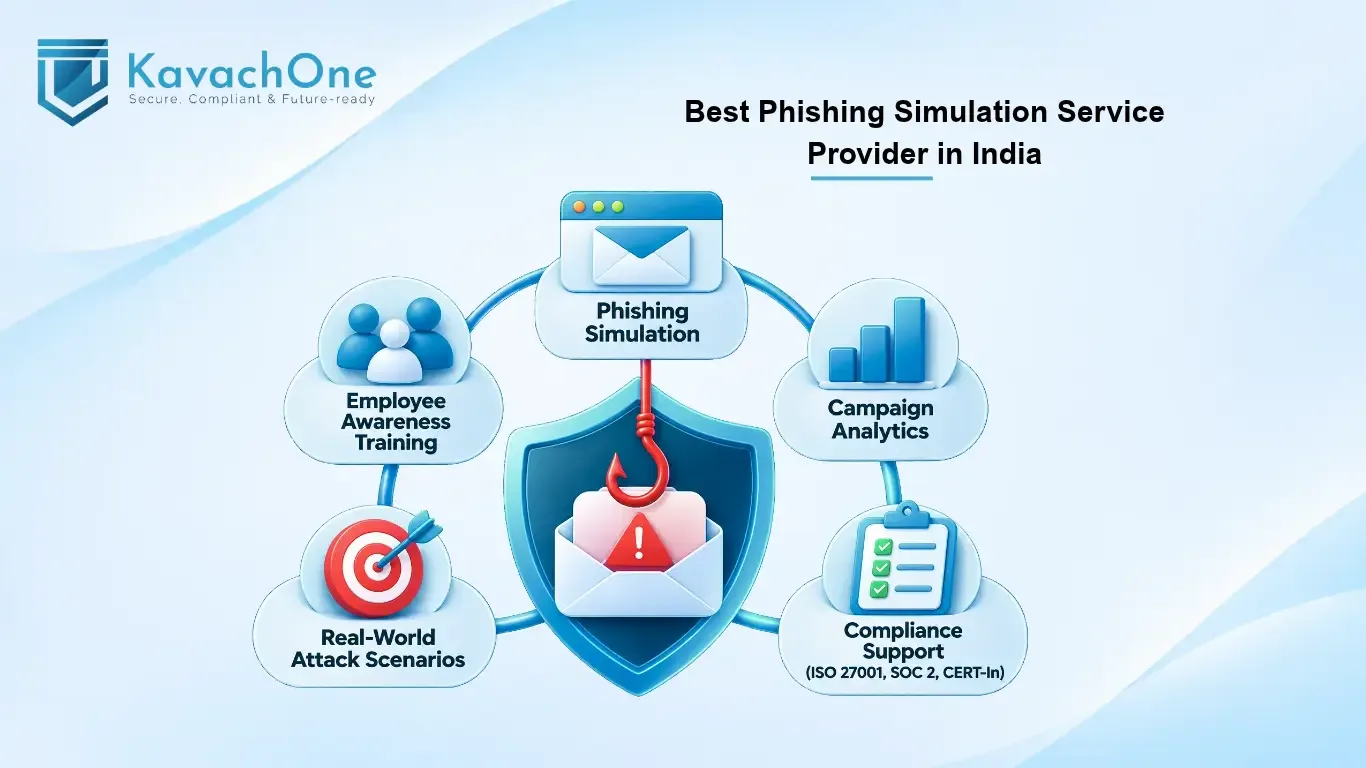

Financial institutions manage some of the most valuable digital assets in the economy, such as customer funds, credit profiles, payment systems, and sensitive personal information (PII). Even though banks, NBFCs, insurance companies, and fintech platforms invest in firewalls, endpoint detection, and encryption, attackers often get around these defenses by targeting employees. Running a structured phishing simulation for BFSI, NBFC, and banking organizations helps security teams assess how prepared employees are for real social engineering attacks before an actual breach occurs.
Growing Phishing Threats in the BFSI Sector
Threat actors focus heavily on the Banking, Financial Services, and Insurance (BFSI) ecosystem because a single compromised employee credential can unlock core banking portals, loan management systems, or payment gateways. Modern social engineering attacks against financial institutions go far beyond generic spam.
Common Phishing Vectors Targeting Financial Institutions
Credential Harvesting on Internal Portals: Attackers replicate Microsoft 365, VPN, or core banking single sign-on (SSO) login pages to capture employee usernames and passwords.
Business Email Compromise (BEC) and Payment Fraud: Impersonating a Director, an Auditor, or a Partner Vendor to authorize an urgent NEFT/RTGS transfer or to change the disbursing bank account.
Regulatory and Compliance Lures: Fraudulent emails disguised as urgent Reserve Bank of India (RBI) inspection notices, CERT-In advisories, or GST/tax portal alerts designed to pressure compliance and finance teams into opening malicious attachments.
KYC and Loan Disbursement Spoofing: Targeted lures sent to branch operations and loan officers mimicking credit bureau updates, customer KYC escalations, or Loan Service Provider (LSP) communications.
Multi-Channel Social Engineering (Smishing & Vishing): Phishing links and urgent OTP or approval requests delivered via SMS, messaging apps, or spoofed voice calls alongside email.
Why Banks and NBFCs Need Phishing Simulation
Traditional annual cybersecurity presentations fail to prepare employees for high-pressure, realistic deception. Banks, NBFCs, insurers, and fintech firms operate across distributed branches, remote call centers, and third-party vendor networks—creating a wide human attack surface.
1. Turning Employees into an Active Line of Defense
A continuous phishing simulation for BFSI, NBFC, and banks exposes staff to controlled, realistic attack scenarios in a safe environment. Instead of panicking or clicking unthinkingly during a real incident, employees build the muscle memory to inspect sender domains, verify payment requests out of band, and report suspicious messages immediately.
2. Financial Fraud Prevention Across High-Risk Teams
Finance, treasury, loan underwriting, and customer support all receive hundreds of external requests daily. Regular testing allows an organization to identify high-risk departments and individual vulnerability patterns early on, thereby preventing wire fraud, rogue loan approvals, and account takeovers before any funds have left the organization.
3. Demonstrating Regulatory and Audit Readiness
Regulators want demonstrable proof that the institution is actually training its staff on cyber threats. The only way to provide that proof is by running documented, realistic phishing simulation campaigns. That provides you with verifiable audit logs of ongoing risk measurement and remediation rather than some one-off checkbox training.
Practical Regulatory & Compliance Requirements in BFSI
Financial institutions in India and global markets face strict mandates around employee security awareness and incident prevention:
Framework / Regulation | Key Expectation for BFSI, NBFC & Fintech Teams |
RBI Cyber Security Framework (Banks & NBFCs) | Mandates continuous cyber awareness programs for employees, board members, and outsourced staff, alongside regular board-level reporting on cyber resilience and incident readiness. |
CERT-In Directions | Requires rapid detection and reporting of cybersecurity incidents within strict timelines—making early employee phishing reporting critical to containing breaches fast. |
DPDP Act 2023 | Requires Data Fiduciaries (including banks, NBFCs, and insurers) to implement reasonable security safeguards to prevent personal data breaches caused by human error or credential theft. |
PCI DSS v4.0.1 | Explicitly requires ongoing security awareness training that includes recognizing and reporting phishing and social engineering attacks to protect cardholder data environments. |
ISO 27001 & SOC 2 | Evaluates whether personnel receive regular security awareness updates and documented testing to mitigate social engineering risks across internal operations. |
Building Effective Employee Phishing Awareness Training
For employee phishing awareness training to measurably reduce risk in a financial institution, simulations must mirror actual operational workflows without disrupting daily banking or lending operations:
Role-Based Scenario Customization: Tailor lures by department—sending vendor invoice and wire-change lures to finance teams, policy and HR updates to branch staff, and IT credential resets to engineering and support teams.
Randomized Drip Scheduling: Stagger email delivery across days and weeks so employees cannot tip each other off in internal chat channels.
Safe Credential-Harvesting Verification: Measure not just who clicks a link, but who actually enters credentials on a simulated login page—without ever capturing or storing real passwords.
Just-In-Time Micro-Learning: Deliver immediate, two-minute interactive feedback the moment an employee clicks a simulated lure, highlighting the exact red flags they missed while the context is fresh.
How KavachOne Secures BFSI, NBFCs, and Banks
Backed by certified security experts and PCI DSS Qualified Security Assessors (QSA), KavachOne delivers an end-to-end phishing simulation for BFSI, NBFCs, and banks designed specifically for high-compliance financial environments.
Key Capabilities of KavachOne’s Phishing Simulation Platform
100% Managed Campaign Orchestration: KavachOne’s security specialists plan, customize, schedule, and manage campaigns end-to-end—eliminating operational burden on internal IT and SOC teams.
BFSI-Specific Attack Templates: Access realistic, up-to-date lures modeled on banking workflows, Microsoft 365/SSO portals, regulatory notices, vendor invoices, and executive requests.
Instant Micro-Learning Modules: Employees who interact with a test lure receive immediate, bite-sized coaching under two minutes to reinforce secure habits without slowing down branch or back-office productivity.
One-Click Phishing Report Integration: Native reporting button integration for Microsoft Outlook and Google Workspace lets staff flag suspicious emails in one click, feeding real-time alerts to security teams.
Live Risk Telemetry & Executive Dashboards: Track Click Rate, Credential Compromise Rate, and Threat Reporting Rate across branches, departments, and user groups to measure risk reduction over time.
Audit-Ready Compliance Documentation: Automatically generate structured training and simulation reports aligned with RBI cybersecurity guidelines, PCI DSS, ISO 27001, SOC 2, and the DPDP Act 2023.
Benefits of Choosing KavachOne for BFSI Organizations
Measurable Drop in Phishing Susceptibility: Continuous testing paired with instant micro-learning steadily lowers credential compromise rates across branches and corporate offices.
Stronger Financial Fraud Prevention: Equips finance, operations, and lending teams to spot BEC, invoice manipulation, and spoofed approval requests before financial losses occur.
Zero-Friction Directory Integration: Seamless synchronization with Microsoft Entra ID (Azure AD), Google Workspace, or CSV rosters ensures that new hires and department transfers are automatically covered.
Unified GRC & Cybersecurity Expertise: Beyond phishing simulation, KavachOne supports financial institutions with VAPT, RBI compliance advisory, PCI DSS audits, ISO 27001/27701 implementation, and DPDP Act data governance.
Strengthen Your Human Firewall with KavachOne
Technical controls alone cannot stop a well-crafted social engineering attack if employees are unprepared. Deploying a managed phishing simulation for BFSI, NBFC, and banking organizations empowers your workforce to detect, verify, and report threats before they affect customer trust or regulatory standing.
Ready to benchmark your organization’s phishing resilience? Connect with KavachOne today to schedule a tailored demo and launch audit-ready phishing simulation campaigns for your bank, NBFC, insurance firm, or fintech team.
Frequently Asked Questions (FAQs)
KavachOne Editorial Team
Cybersecurity & Compliance Experts