
Digital transformation in banking, financial services, and insurance (BFSI) depends on customer data. Whether it’s approving personal loans, assessing credit, or offering wealth management products, data drives today’s financial transactions.
Now that India’s Digital Personal Data Protection (DPDP) Act is in force, along with strict RBI rules on digital lending and data security, bundled opt-ins and passive consent are no longer allowed. Financial institutions are now Data Fiduciaries, and many qualify as Significant Data Fiduciaries (SDF). Non-compliance can lead to penalties of up to ₹250 crore.
Consent Lifecycle Management (CLM) in banking is no longer just a checkbox on an onboarding screen. It has become a key part of today’s digital financial systems.
What does Consent Lifecycle Management mean in the context of the BFSI sector?
Consent Lifecycle Management (CLM) is an automated system that assists financial institutions at every stage in capturing, recording, validating, updating, revoking, and auditing customer consent.
In the banking and financial services industry, obtaining consent is not a single occurrence. For instance, a customer might grant permission as part of the e-KYC process, permit temporary access for a credit check, re-ensure existing permissions, or, at a later date, withdraw their consent for profiling. A specific CLM system ensures that these detailed preferences govern how data is used across banking systems, loan platforms, CRM tools, and fintech APIs in real time.
Why Banking and BFSI Institutions Need Robust Consent Lifecycle Management
Every day, the financial services sector handles highly sensitive personal and financial data. The use of a dynamic CLM helps in overcoming four major challenges facing the industry.
1. Navigating DPDP Act Mandates and Multi-Regulatory Pressure
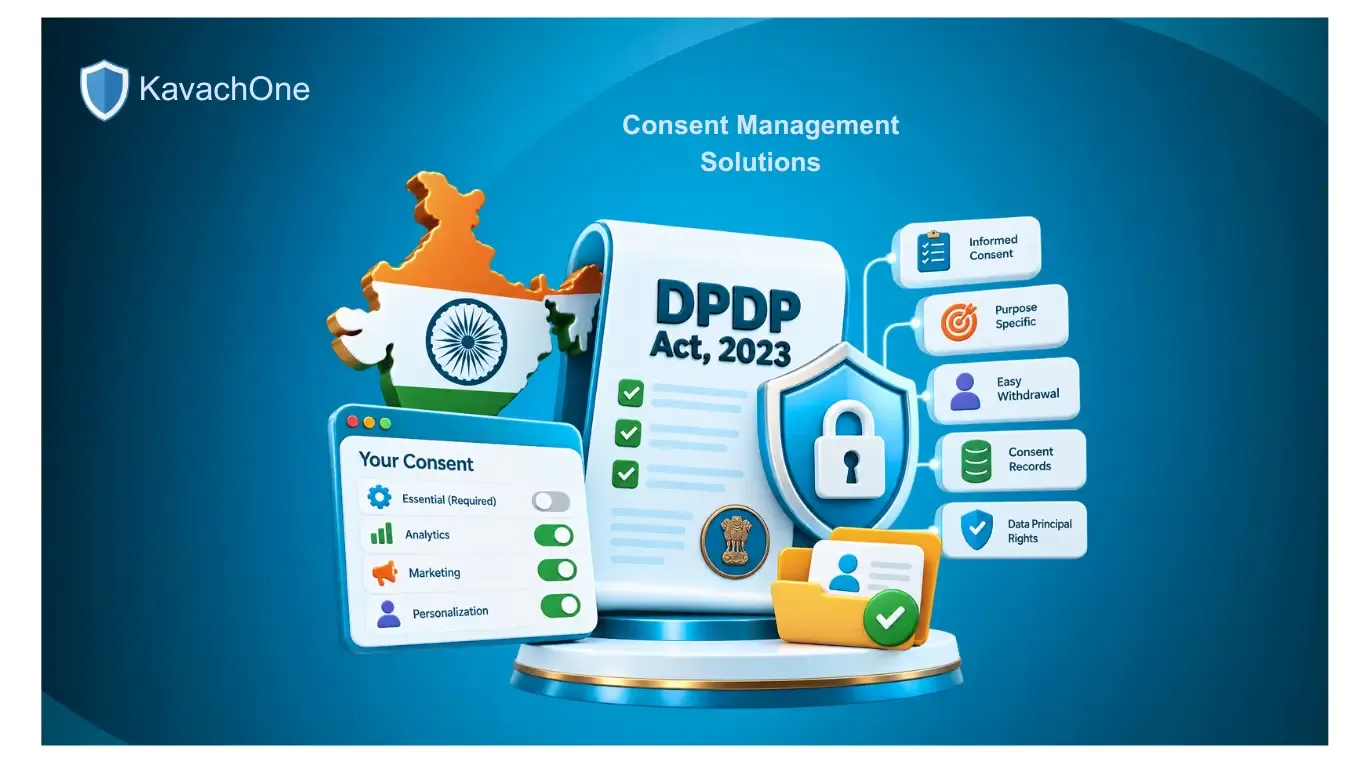
Under Section 6 of the DPDP Act, consent must be:
Free, specific, informed, unconditional, and clear.
Shown by taking clear and affirmative action (with no checkboxes pre-ticked).
With an English-language notice and one for each of the 22 scheduled Indian languages.
As easy to withdraw as it was to grant.
At the same time, banks have to reconcile privacy rules with legal obligations, such as record-keeping requirements under the Prevention of Money Laundering Act (PMLA) and the RBI's guidelines on digital lending. To protect privacy without violating the law, a special type of CLM separates operational consent from legal processing.
2. Eliminating Fragmented and Siloed Data Architectures
Large retail banks and NBFCs make use of a variety of channels, including branch kiosks, online banking, mobile apps, WhatsApp bots, and partner apps. If a customer declines promotional calls through the app without a unified consent system, this preference is often not reflected in the call center's CRM, leading to compliance issues.
3. Reducing the risks associated with third parties and the ecosystem
The BFSI sector places a great deal of trust in API networks, such as those provided by data vendors, account aggregators, payment gateways, and insurance data-sharing platforms. When a customer withdraws their permission to share data, this change must be rapidly reflected across all connected fintech APIs.
4. Overcoming "Per-Consent" Cost Traps
Global consent management platforms (CMPs) bill banks on a per-consent or per-API-call basis. The costs of this can become substantial quite quickly for retail banks that handle millions of transactions and user actions each month.
The 6 Stages of the Consent Lifecycle in BFSI
Stage 1: Itemized Notice & Clear Disclosure
Before requesting consent, financial institutions must give a clear, separate notice. This notice should list the exact data collected, the reasons for collecting it (such as credit checks or fraud detection), and the contact details for the Data Protection Officer (DPO) and the Grievance Officer.
Stage 2: Granular Consent Capture
The DPDP Act does not permit bundled consent. When customers sign up or apply for credit, they should be able to select each permission individually. For instance, they can agree to account aggregation yet refuse permission for third-party marketing.
Stage 3: Digital Consent Artifact Generation
Each time consent is given, a secure and tamper-proof digital record must be created. This record includes:
Identity of the Data Principal (customer)
Exact purpose string consented to
Timestamp, device fingerprint, and IP address
Language and version of the notice displayed
Stage 4: Preference Management & Expiry Handling
Consent is not permanent. Financial institutions should offer self-service options so customers can view, change, or extend their permissions. Expiration rules should also be set for consent tokens to prevent the use of outdated data.
Stage 5: Instant Revocation and Downstream Propagation
The DPDP Act stipulates that withdrawing one's consent should be just as easy as giving it. If a user clicks 'Withdraw Consent', the system must immediately cease all data processing across the various marketing tools, data storage, and third-party vendors via webhooks and APIs.
Stage 6: Audit-Ready Logging and DSAR Fulfillment
Financial fiduciaries should be prepared to demonstrate that consent was valid when questioned by the Data Protection Board of India (DPBI) or during statutory audits. Additionally, when customers exercise their Data Subject Access Rights (DSAR)—for example, the right to have data corrected or erased—the CLM is responsible for carrying out the necessary actions across all systems.
How KavachOne Solves Consent Management for BFSI Enterprises
While most global consent management platforms were initially created for European cookie banners (GDPR) and have since been modified to suit other markets, ConsentiQo by KavachOne was designed from the beginning to comply with Indian regulations, the DPDP Act, and BFSI requirements.
1. DPDP Section 6-Native Architecture
KavachOne offers a purpose-first consent system from the start. It removes pre-ticked options, makes banking disclosures clear and detailed, and keeps notice and consent steps separate across apps, websites, and branches.
2. Comprehensive 22-Language Localization
Financial inclusion requires reaching customers in their primary languages. KavachOne features native support for all 22 official Indian scheduled languages. This ensures customers in Tier 2, Tier 3, and rural markets comprehend consent notices in Marathi, Tamil, Bengali, Hindi, Telugu, or Gujarati, preventing claims of uninformed or invalid consent.
3. Automated Consent Artifacts and 7-Year Audit Trail
Every time a user acts, a secure, tamper-evident digital record is created, complete with full audit information. KavachOne retains these consent logs for 7 years, thereby fulfilling legal record-keeping requirements and enabling rapid exports in CSV or PDF format for audits and DPBI checks.
4. Real-Time Revocation Sync Across Complex Banking Stacks
The KavachOne system synchronizes consent status across Salesforce, Finacle, loan systems, customer data platforms, and credit bureaus via two-way webhooks and fast APIs. As soon as a customer's consent is received, the data pipelines cease, eliminating delays and reducing regulatory risk.
5. Verifiable Minor and Guardian Workflows
Digital banking products for students and minors must meet strict rules under DPDP Section 9. KavachOne has built-in parent or guardian checks and age verification, helping fintechs and savings programs manage minor data safely.
6. Predictable Enterprise Pricing (No Per-Consent Tax)
In contrast to traditional providers that charge on a per-user opt-in or per-API-call basis, KavachOne has a straightforward and transparent fee system that enables large-volume retail lenders and neo-banks to scale their digital transactions without incurring unexpected software costs.
Technical Comparison: Global CMPs vs. KavachOne for Indian BFSI
Feature / Requirement | Generic Global CMPs (GDPR-focused) | KavachOne (ConsentiQo) |
Regulatory Alignment | GDPR / CCPA adaptations | 100% DPDP Act native (Section 6 & 9) |
Language Support | English + primary global languages | All 22 Scheduled Indian Languages |
Pricing Model | Metered per-consent / API charge | Predictable flat enterprise pricing |
Downstream Propagation | Limited to web tracking & tags | Deep sync across CRMs, CBS, LOS & CDPs |
Audit Log Retention | Typically 12–24 months | 7-year audit retention with PDF/CSV export |
Deployment Speed | 6 to 12 months custom build | Production-ready in 3 to 6 weeks |
Data Localization | Often routed through foreign servers | India-hosted, DPBI-registration ready |
Best Practices for Implementing CLM in Banking Operations
Conduct a Granular Data-to-Purpose Audit: Map every data attribute captured across digital forms to its specific legal basis and business requirement.
Separate compulsory permissions from optional ones: users should not be required to consent to cross-selling, behavioral profiling, or promotions from external partners when performing basic account or loan activities.
Standardize Consent Tokens Across Microservices: Assign unique Consent IDs to user profiles and validate the token before initiating automated marketing or scoring runs.
Establish a One-Stop Privacy Dashboard: Provide customers with a centralized self-service preference center inside the mobile banking app.
Automate DSAR handling: Use a standard process instead of manual emails to manage customer rights requests.
Future-Proof Your Financial Institution with KavachOne
In the evolving BFSI landscape, customer trust is inseparable from regulatory compliance. Consent can no longer remain a fragmented afterthought.
KavachOne provides banking and fintech leaders with a complete, enterprise-grade consent management infrastructure designed specifically for Indian regulatory requirements. By automating consent collection, streamlining real-time revocation, and delivering comprehensive audit trails, KavachOne turns privacy compliance into a competitive advantage.
To see how consent automation works in real-world deployments, check out this walkthrough of KavachOne's DPDP Consent Management Platform.
Frequently Asked Questions (FAQs)
KavachOne Editorial Team
Cybersecurity & Compliance Experts