
Every second, modern healthcare systems produce enormous amounts of sensitive patient data. From electronic health records (EHRs) and laboratory tests to telemedicine appointments and AI-driven imaging, everyday clinical activities are closely tied to digital networks.
The rapid pace of change in digital health necessitates strict regulatory accountability. The India Digital Personal Data Protection (DPDP) Act has completely changed the way hospitals, digital health platforms, diagnostic service chains, and health-tech companies collect, handle, and store patients' records. It is no longer acceptable to treat patient consent as simply a signed physical form or a vague digital tick-box. The DPDP Act imposes serious administrative fines for any failure to follow procedures or for non-compliance, with fines up to ₹250 crore.
At KavachOne, we help healthcare organizations manage the challenge of balancing complex clinical workflows with strict data privacy rules. Adopting a dedicated, automated Healthcare Consent Management Platform (CMP) is no longer just an IT task. It is now essential for clinical, operational, and legal reasons.
DPDP Act Mandate: Patient Consent Architecture for Healthcare Providers
The DPDP Act recognizes patients as Data Principals, and hospitals, clinics, and health-tech companies serve as Data Fiduciaries. Third-party vendors, such as cloud storage providers, billing aggregators, and diagnostic SaaS platforms, act as Data Processors.
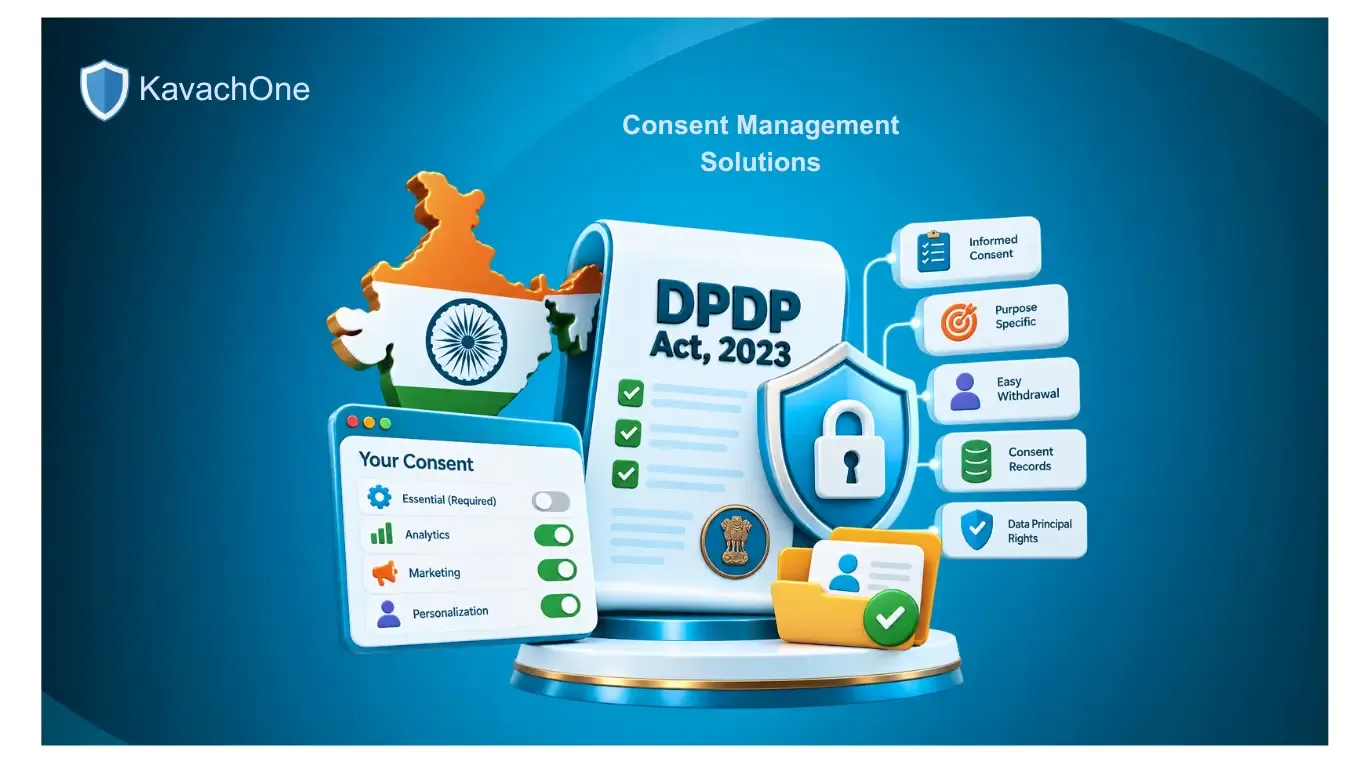
To satisfy regulatory thresholds, patient data consent must adhere to six statutory criteria:
Free: Patients cannot be pressured into surrendering personal data to receive standard medical treatment.
Specific: Consent cannot be general. Authorizing a routine blood test does not authorize clinical trials, pharma marketing, or insurance cross-selling.
Informed: The patient must receive an itemized privacy notice detailing the precise categories of data gathered, specific processing purposes, contact details of the Data Protection Officer (DPO), and redressal pathways.
Unconditional: Access to core medical services cannot be contingent on consent to the collection of auxiliary, non-essential data.
Unambiguous: Implied, tacit, or presumed consent is invalid under the law. Affirmative, clear opt-in actions are strictly required.
Revocable: Data Principals have the explicit legal right to withdraw consent at any time, using an interface as simple as the one used to grant it.
Clinical Consent vs Digital Patient Data Consent Under DPDP Rules
Many healthcare administrators mistakenly treat clinical treatment consent as equivalent to consent for the use of digital personal data. However, these two types of consent serve very different legal purposes.
Clinical Consent: Governed by traditional medical ethics, National Medical Commission regulations, and precedents like Samira Kohli v. Dr Prabha Manchanda. It ensures that patients comprehend procedural risks, clinical alternatives, and surgical ramifications before intervention.
Digital Patient Data Consent: Governed strictly by the DPDP Act. It regulates how digital identities, biometric records, diagnostic imaging, prescriptions, insurance numbers, and billing data are captured, transmitted, stored, and analyzed across digital infrastructure.
While emergency medical treatment may be exempt under certain circumstances, outpatient care, diagnostic tests, teleconsultations, and elective procedures all require verified consent for the use of digital data.
Patient Data Privacy Risks & Compliance Gaps in Hospital Workflows
Healthcare organizations handle complex digital workflows that often create regulatory risks:
Unbundled Secondary Use
It is common for hospitals to use contact records from their registration desks for supplementary activities, such as promoting annual executive health checks, seasonal vaccination campaigns, or wellness newsletters. The DPDP Act considers it a direct breach to treat an outpatient consultation as an opportunity for marketing purposes without first obtaining separate and specific consent.
Third-Party Health-Tech & API Leakage
Today’s digital healthcare operations rely on various outsourced software systems, including SMS gateways, cloud image archives (PACS), payment processors, and video tools for teleconsultations. Healthcare organizations often share patient data with these third-party service providers to deliver digital services efficiently. Organizations must clearly define how these providers can process and use patient data. Without appropriate agreements, controls, and oversight, third-party data processing can pose significant risks to patient data privacy and DPDP compliance for healthcare organizations.
Pediatric and Minor Patient Data Governance
The DPDP Act sets strict rules for handling personal data of minors, meaning anyone under 18. Healthcare providers must have clear, verifiable ways to get consent from a parent or guardian before creating digital profiles, assigning app credentials, or recording health data for children.
Unprotected Hybrid Documentation
Much of healthcare still uses a mix of paper and digital methods, like handwritten intake forms, printed discharge summaries, and scanned diagnostic reports stored on local computers. These practices create compliance risks during a Data Protection Board of India (DPBI) inquiry, because there are often no access controls, audit logs, or central systems for managing records.
Implementing an End-to-End Healthcare Consent Management Lifecycle
To stay compliant, healthcare organizations need more than just paper forms. They should use an automated consent management system that connects with all administrative and clinical processes.
Lifecycle Stage | Regulatory Requirement | Operational Implementation |
1. Purpose Capture | Granular, itemized, multilingual notice | Dynamic modal displays, self-service check-in kiosks, digital signature pads |
2. Immutable Logging | Verifiable, tamper-evident consent records | Cryptographically time-stamped logs, metadata tags, notice version tracking |
3. Purpose Enforcement | Strict data access limitation | Role-Based Access Controls (RBAC) linked to active consent parameters |
4. Rights Fulfillment | Frictionless access, correction, and erasure | Dedicated self-service privacy portals, automated DPO ticket management |
5. Revocation Sync | Seamless right to withdraw consent | Real-time webhook notifications that halt downstream non-essential processing |
Technical Challenges in Health Data Retention & ABDM Interoperability
Turning regulatory requirements into operational hospital IT systems is complex, and most traditional Hospital Information Management Systems (HIMS) are not well equipped to handle these challenges.
Harmonizing Erasure Rights with Medical Record Retention Laws
There is a key conflict between the DPDP Act’s Right to Erasure and healthcare regulations. Privacy laws allow patients to request data deletion. Still, the Indian Medical Council rules require hospitals to retain inpatient records for at least 3 years, and even longer for children or legal cases.
A smart Consent Management Platform (CMP) solves this problem by automatically separating data. When a patient requests data deletion, non-essential profiles, analytics, and marketing tags are permanently deleted. Required clinical records are moved to secure storage with limited access until the legal retention period ends.
Multilingual Notice Delivery Across 22 Languages
India officially recognizes 22 languages, and the DPDP Act requires that notices be easy to understand in these languages. Using only English privacy policies does not meet this rule. Digital healthcare apps and bedside portals must show consent information in the patient’s chosen language without making the interface harder to use.
Ayushman Bharat Digital Mission (ABDM) Integration
With the Ayushman Bharat Digital Mission (ABDM), patient records connect to Ayushman Bharat Health Accounts (ABHA) through Health Information Exchange-Consent Managers (HIE-CM). Hospitals need to ensure their databases integrate smoothly with national health exchange consent systems to avoid problems and conflicting records.
How KavachOne Solves DPDP Compliance with Automated Healthcare CMP
Meeting healthcare data privacy requirements calls for an architecture that ensures compliance with statutory privacy requirements without hindering the delivery of clinical services. KavachOne is an enterprise data privacy and consent management infrastructure designed with India's regulatory requirements in mind.
ConsentiQo by KavachOne: Purpose-Built Consent Management
ConsentiQo, KavachOne’s main consent platform, turns complex DPDP rules into automated, easy-to-use modules for developers. These modules fit easily into web portals, patient apps, and hospital management systems:
Multilingual Consent Deployment: Native support for 22+ scheduled Indian languages, ensuring transparent, legally sound consent notices across OPD kiosks, diagnostic check-in counters, and patient apps.
Granular Purpose Separation: Disaggregates general clinical care from third-party diagnostics, telehealth video routing, and optional wellness messaging, preserving clear legal demarcations.
Streamlined Patient Privacy Centers: Provides patients with an intuitive, self-service dashboard to review active consents, update preferences, or withdraw permissions without manual hospital paperwork.
Tamper-Evident Audit Trails: Every consent capture, version update, and withdrawal generates a cryptographically verifiable record, supplying compliance teams with auditable evidence for DPBI reviews.
Flexible Technical Integration: Connects effortlessly via lightweight SDKs and REST APIs into legacy hospital HIMS, Next.js web applications, and mobile environments without adding latency to clinical interactions.
Building a Patient-First Data Architecture
In healthcare, patient care depends on patient trust. To keep that trust, the DPDP Act requires a data governance system that is clear and easy to show in practice.
Hospital administrators and digital health professionals can eliminate regulatory exposure, respect patient autonomy, and establish a secure, future-ready medical enterprise by using a specialized Healthcare Consent Management Platform.
KavachOne helps healthcare organizations streamline consent management, maintain secure audit trails, manage data processing purposes, and support DPDP compliance across connected systems. Contact our team to learn how KavachOne can help your organization build a secure, compliant, and patient-first data architecture.
Frequently Asked Questions (FAQs)
KavachOne Editorial Team
Cybersecurity & Compliance Experts