
Early-stage Indian startups used to focus on launching features fast, gaining users quickly, and postponing legal compliance until after Series A funding.
Now, with the DPDP Act fully in effect and enforcement deadlines approaching, that old approach no longer works.
The DPDP Act applies to all companies, regardless of size. There are no exceptions for small businesses or minimum turnover. If you handle digital personal data of Indian citizens, even basic details such as names or email addresses, you are a Data Fiduciary. With penalties of up to ₹250 Crore per violation, compliance is now essential to stay in business.
Building your own compliance infrastructure takes months of engineering bandwidth, while legacy global tools built for Western frameworks fall short of India's unique regulatory landscape. To scale safely, your business needs an automated, dedicated DPDP compliance tool.
What is a DPDP Compliance Tool?
A DPDP compliance tool is software that helps organizations automate, monitor, and stay compliant with India’s Digital Personal Data Protection (DPDP) Act, 2023.
The Core Pitfall: Why Global GDPR Tools Aren't Built for India's DPDP Act
Many founders assume that integrating a standard, Western Consent Management Platform (CMP) built for GDPR or CCPA is enough. It isn't. The DPDP Act introduces highly specific workflows that foreign tools simply aren't engineered to handle:
The DPDP Act requires notice and consent to be provided in English and all 22 official Indian languages. Standard European CMPs cannot accurately display privacy notices in local languages like Marathi, Tamil, or Assamese.
India’s rules require integration with registered, interoperable Consent Managers, which is a feature unique to the Indian system.
No Pre-Ticked or Bundled Boxes: Unlike the looser interpretations used by some global plugins, the DPDP Act demands that consent be explicitly free, specific, informed, unconditional, and unambiguous. A single "I agree to the Terms and Privacy Policy" checkbox is an instant violation.
India Data Residency: Foreign privacy suites often route, analyze, or back up your system metrics through international cloud nodes. Given the evolving cross-border data transfer mandates in India, keeping your compliance data local is the safest strategy.
DPDP Compliance Challenges for Indian Startups
For most Indian startups, complying with the Digital Personal Data Protection (DPDP) Act isn't just about understanding the law—it's about implementing the right processes while continuing to grow the business. Unlike large enterprises with dedicated legal teams, startups operate with limited resources, making data privacy a significant challenge. As customer data grows, managing compliance manually becomes complex, error-prone, and highly risky.
Under the DPDP Act, early-stage startups face the same strict rules and heavy penalties as tech giants. Navigating these roadblocks requires shifting away from manual spreadsheets and adopting automated, India-first privacy systems.
4 Core Compliance Hurdles for Lean Teams
Resource and Bandwidth Constraints: Startups rarely have dedicated Data Protection Officers (DPOs) or privacy engineers. Building custom data-mapping frameworks or consent pipelines pulls critical developer bandwidth away from shipping product features.
The 22-Language Mandate: The DPDP Act requires privacy notices to be accessible in English and all
22 scheduled languages of the Indian Constitution. Building and maintaining legally accurate, multilingual consent screens from scratch creates massive engineering friction.
Fragmented User Data (DSARs): Indian citizens have the right to access, correct, or completely erase their data. Because startup data is often scattered across production databases, CRMs, and third-party SaaS tools, fulfilling these requests manually within strict statutory timelines is an operational nightmare.
Third-Party API Risks: Startups rely heavily on external plugins, payment gateways, and analytics tools. If a third-party integrated service leaks personal data, the startup remains legally liable as the primary Data Fiduciary.
How KavachOne’s Automated Privacy Suite Protects Your Startup
KavachOne engineered its platform from the ground up as a native DPDP compliance tool for startups. Instead of forcing you to choose between legal safety and engineering speed, KavachOne automates up to 80% of the manual workload required to remain fully audit-ready.
1. ConsentiQo: Native Indian Consent Management
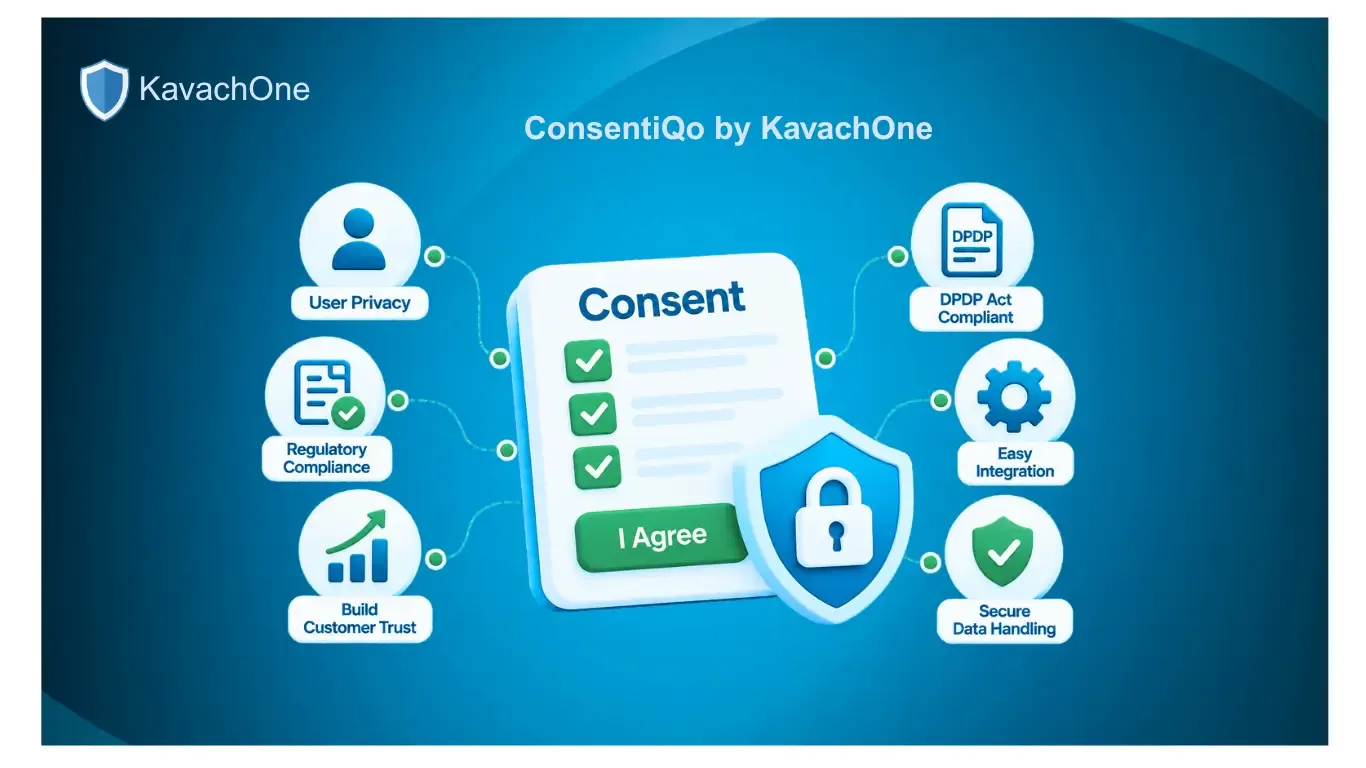
ConsentiQo, KavachOne’s built-in CMP, handles the whole consent process automatically, from user sign-up to data deletion requests.
Granular Opt-ins: Move away from illegal "Accept All" checkmarks. Give users clear, specific choices over their data.
Multilingual Support: Natively supports all 22 scheduled Indian languages, ensuring your user notice is perfectly clear whether your customer is in Mumbai or a Tier-3 town.
Instant Revocation Workflows: The DPDP Act states that withdrawing consent must be as easy as giving it. When a user opts out via ConsentiQo, the tool dynamically updates your database and downstream applications, eliminating manual processing delays.
2. Zero-Data-Egress PII Scanner
You cannot protect data you do not know exists. KavachOne’s AI-powered PII (Personally Identifiable Information) scanner works entirely within your own local environment. It searches your databases, identifies hidden repository stores, and flags specific Indian identifiers such as Aadhaar, PAN, GSTIN, and UPI IDs without ever allowing that sensitive data to leave your secure perimeter.
3. Automated ROPA and Triggered DPIAs
Maintaining a manual Record of Processing Activities (ROPA) is a logistical nightmare for an agile startup. KavachOne auto-populates your ROPA dynamically by linking directly to the outputs of your data scans. Furthermore, if the system flags a high-risk data-processing change, it triggers an automated Data Protection Impact Assessment (DPIA) workflow, keeping your internal risk assessments up to date without draining your product team's time.
The Startup Advantage: Comparing the Approaches
Compliance Parameter | Legacy/Generic Privacy Tools | KavachOne Automated Privacy Suite |
Primary Regulatory Focus | GDPR / CCPA (Western focus) | 100% DPDP-First by Design |
Language Localization | Limited / English-centric | Fully supports 22 Scheduled Indian Languages |
Audit Log Longevity | Basic / Volatile sessions | Secure, 7-Year Tamper-Proof Trail |
Local Identifier Detection | Low (misses unique Indian IDs) | High-accuracy for Aadhaar, PAN, GSTIN, UPI |
Integration Complexity | Weeks of developer hours | Lightweight SDKs / Set up in days |
Ready to Make Your Startup DPDP Compliant?
Manual processes and complex compliance shouldn’t slow your business. KavachOne’s DPDP Compliance Platform lets startups automate consent management, locate personal data, manage privacy policies, assess vendor risks, and stay audit-ready from a single dashboard.
Book a Free DPDP Compliance Demo Today and see how KavachOne can simplify your privacy compliance journey.
Frequently Asked Questions (FAQs)
Do Indian startups need to comply with the DPDP Act?
Yes. The DPDP Act covers any organization that handles digital personal data of people in India. Whether you are a startup or a large company, you must comply with the Act if you collect or use personal data.
Why aren't GDPR compliance tools enough for Indian startups?
Most GDPR tools are designed around European privacy regulations and may not support DPDP-specific requirements such as multilingual consent notices, India's Consent Manager framework, or the handling of Indian identifiers like Aadhaar, PAN, and GSTIN. Indian startups should use a solution designed specifically for the DPDP Act.
How does KavachOne help startups achieve DPDP compliance?
KavachOne makes DPDP compliance easier by automating important privacy tasks. It handles consent management with ConsentiQo, finds personal data using AI, creates ROPA automatically, manages policies, checks vendor risks, and prepares reports for audits, all in one place.
Is manual DPDP compliance suitable for growing startups?
Manual compliance might be okay for very small businesses at first, but it gets harder as you handle more customer data, integrate with other services, and navigate more rules. Automated tools help reduce errors, save time, and make compliance easier to manage.
What are the risks of not complying with the DPDP Act?
If you do not follow the DPDP Act, you could face large fines, damage to your reputation, loss of customer trust, business problems, and more attention from regulators. Using a DPDP compliance solution helps reduce these risks by tracking compliance and automating key tasks.
KavachOne Editorial Team
Cybersecurity & Compliance Experts