
The rapid evolution of open banking, multi-party lending, and real-time payments has positioned modern fintech platforms as absolute masterminds of data processing. However, with the enforcement of strict regulations like India's Digital Personal Data Protection (DPDP) Act, user data is no longer a free-for-all resource.
Fintech platforms are facing an entirely new operational roadblock: DPDP Consent Management.
Simple cookie banners and bundled terms-of-service agreements no longer satisfy regulators. Non-compliance can lead to penalties up to ₹250 Crore per violation under DPDP rules. For fast-growing fintechs, managing changing user preferences across complex API networks is a critical compliance requirement.
Below, we outline the main consent management challenges in fintech and show how KavachOne’s ConsentiQo platform addresses them.
Why DPDP-Compliant Consent Management Matters for Fintech Companies
Trust is crucial for fintech companies. When users share their bank details, payment data, and personal information, they expect privacy, transparency, and control. Consent management is now a key part of compliance and user experience in every fintech product.
Weak consent practices can result in regulatory fines, damage to reputation, and slower product launches. On the other hand, strong consent management helps with compliance, audit readiness, and building customer trust.
Top DPDP Consent Management Challenges Facing Fintech Companies
1. Fragmented Consent Records Across Fintech Systems
Most fintechs collect data via multiple channels: web forms, mobile apps, payment gateways, and third‑party APIs. Consent often ends up scattered across databases, CRMs, and legacy systems, making it hard to track when and how consent was given.
This fragmentation leads to weak audit trails, inconsistent handling when users revoke consent, and makes it difficult to prove compliance if regulators ask for a specific user’s consent record.
2. Poor User Experience Reducing Consent Completion Rates
Long, complicated notices, confusing buttons, and unclear language often cause users to skip consent or just click “Accept” without understanding. This lowers informed consent rates and can lead to more disputes or opt-outs later.
In multilingual markets like India, if notices are not in the user’s native language, it becomes even harder for users to understand and trust how their data is handled.
3. Managing Granular and Dynamic Consent Lifecycles
Fintech products often need detailed consent for things like payment processing, marketing, profiling, sharing with partners, or open-banking APIs. Users might agree to some uses but not others, and these permissions can change over time.
Managing one-time consents, like KYC sharing, versus ongoing ones, like regular report generation, is difficult and error-prone without a strong system to handle the consent lifecycle.
4. DPDP Compliance and Cross-Border Data Transfer Challenges
Fintechs serving global users must comply with GDPR, India’s DPDP Act, and other regional rules, each with different consent requirements (explicit, informed, withdrawable, documented).
Cross‑border data transfers, especially to third‑party processors or cloud providers, add another layer of complexity around consent scope and lawful‑basis documentation.
5. Data Discovery and Mapping for Consent Governance
Before collecting consent, fintech companies need to know what data they use, where it is stored, and who it is shared with. Without clear data mapping, consent notices remain vague and unclear.
This gap makes it difficult to answer “what data is covered under this consent?” during audits or customer inquiries.
Business Risks of Poor Consent Management in Fintech
Poor consent management does not just cause technical problems; it also affects the business’s bottom line:
Regulatory fines and enforcement actions under DPDP, GDPR, and other data‑protection laws.
Loss of customer trust and higher churn if users feel they have no control over their data.
Slower product launches and integration cycles due to manual consent review and legal checks.
Increased audit and remediation efforts every time regulators or customers ask for evidence.
A strong consent management system turns these risks into a competitive advantage: faster compliance, better UX, and smoother scaling.
How KavachOne Solves Fintech Consent Challenges
KavachOne’s consent management approach is designed to solve the main problems fintechs face: fragmented records, complexity, and lack of control.
1. Centralized consent repository
KavachOne provides one secure place for all consent records. Every user choice for onboarding, payments, KYC, or marketing is stored with clear timestamps, notice versions, and channel details.
This central system makes it easy to:
Retrieve consent history for any user in seconds.
Track when consent was given, changed, or revoked.
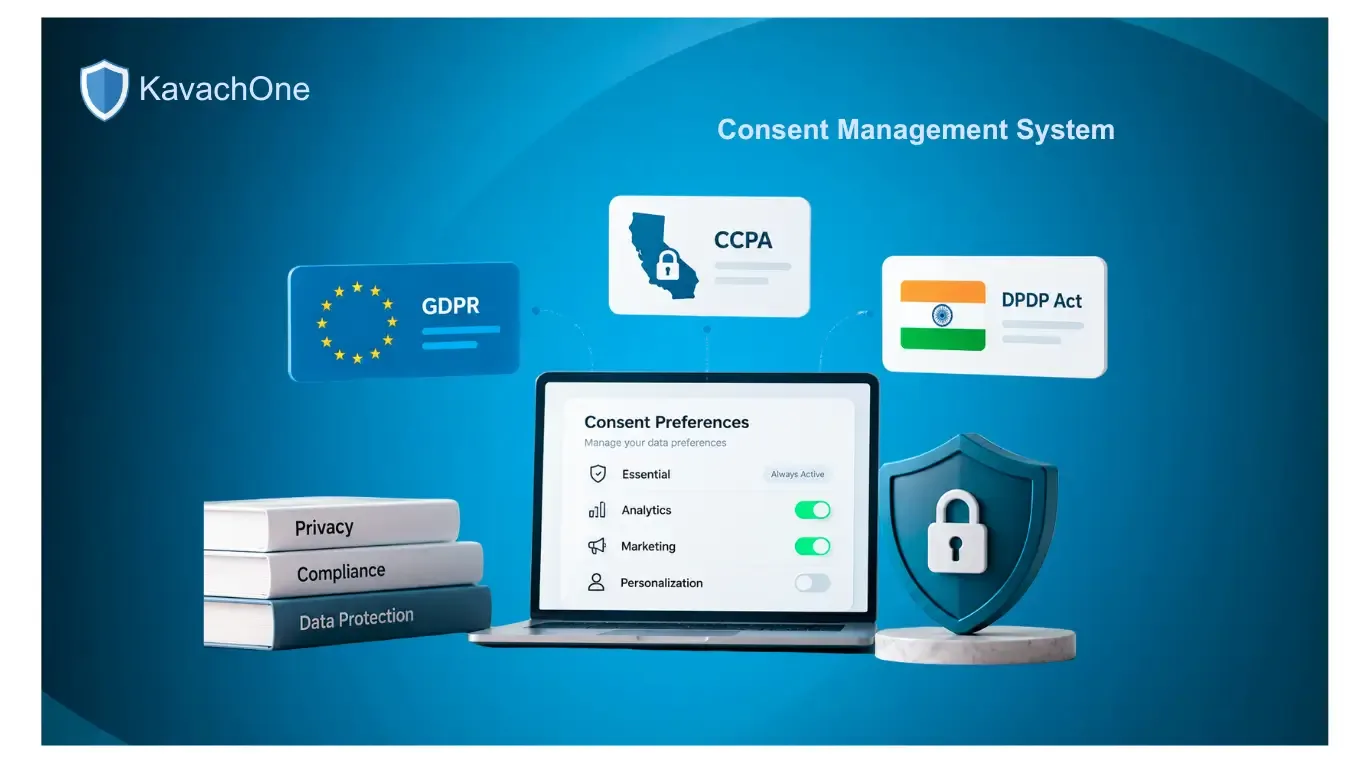
Demonstrate audit‑ready records for DPDP, GDPR, or other frameworks.
2. Automated consent lifecycle workflows
From first‑time sign‑up to revocation and renewal, KavachOne automates the consent lifecycle. Workflows can:
Trigger consent reminders before expiry or major policy changes.
Enforce mandatory consent for specific use cases (e.g., open‑banking sharing).
Automatically revoke access to downstream systems when users withdraw consent.
Automation helps reduce manual errors, keeps processes consistent, and speeds up the time from product launch to compliance.
3. Multi‑language, user‑friendly notices
KavachOne helps fintechs design clear, concise consent notices in multiple languages and formats (web, mobile, in‑app). Templates can be pre‑approved by legal teams and reused across products.
This improves:
User comprehension and informed choices.
Completion rates for critical consents.
Consistency between product and marketing communications.
4. Compliance‑ready reporting and audit evidence
For fintechs facing regular audits (DPDP, GDPR, SOC 2, PCI‑related elements), KavachOne generates ready‑made reports and evidence packs. These include:
Consent logs per user, per product, or per data‑processing activity.
Version history of consent notices and updates.
Proof of withdrawal handling and data‑deletion workflows.
Teams can turn days of manual evidence collection into just a few clicks, making audits faster and less stressful.
5. Integration with fintech stacks
KavachOne is designed to plug into common fintech environments:
Bank and payment APIs that require explicit consent for data sharing.
KYC and identity‑verification providers.
CRM, marketing automation, and analytics platforms where consent‑based profiling is critical.
This integration makes sure that consent decisions are applied consistently in both customer-facing and internal systems.
Quick Implementation Checklist for Fintechs
If you are a fintech looking to implement or upgrade your consent management with KavachOne, follow this short checklist:
Map your data flows and consent touchpoints – Identify every place where you ask for consent (onboarding, KYC, payments, marketing, APIs).
Define consent categories and scopes – Separate essential (e.g., KYC) from non‑essential (e.g., promotions) consents and align with DPDP/GDPR rules.
Design multilingual, user‑friendly notices – Collaborate with legal and UX to create clear, layered notices using KavachOne templates.
Integrate KavachOne into key systems – Connect APIs or SDKs to your web, mobile, and backend platforms to capture consent in real time.
Test consent workflows end‑to‑end – Validate that granting, updating, and revoking consent triggers the right system changes.
Prepare for audits – Use KavachOne reports to create evidence packs and run mock audits before regulators arrive.
This checklist can be turned into a downloadable PDF or a one‑page checklist on your site to generate leads.
How to Get Started with KavachOne
Consent management shouldn’t slow down your fintech innovation—it should help you move forward. With KavachOne, you can:
Centralize all consent records in one auditable system.
Automate consent workflows and lifecycle management.
Improve user trust and compliance posture with minimal manual effort.
If you are a fintech (neobank, payment app, lending platform, or wealth‑tech product) looking to streamline consent for DPDP, GDPR, or other frameworks, schedule a demo with KavachOne or request a custom consent‑management checklist tailored to your stack.
Frequently Asked Questions (FAQs)
KavachOne Editorial Team
Cybersecurity & Compliance Experts