
With the introduction of India’s Digital Personal Data Protection (DPDP) Act, 2023, the way companies handle data has changed for good. Data protection is now a legal requirement, not just a box to tick during audits. If organizations fail to implement proper security measures or mishandle consumer data, they risk regulatory fines of up to ₹250 crore per violation.
Both fast-growing startups and established Indian companies find it challenging to stay compliant across multiple cloud platforms, legacy databases, and numerous customer touchpoints. Relying on manual spreadsheets or separate legal templates is not enough to keep up with ongoing regulatory changes or manage consent effectively.
To solve these challenges and stay flexible, organizations need a reliable, all-in-one solution. This is where KavachOne comes in as your trusted data privacy partner for easy DPDP Act compliance. KavachOne combines automated privacy tools with certified audit expertise, turning complex legal rules into a simple, daily business benefit.
The Operational Realities of India's DPDP Act
According to the DPDP Act, companies that collect personal information are regarded as Data Fiduciaries, and customers, employees, and users are considered Data Principals. The legislation focuses on data handling by emphasizing transparency, purpose limitation, and absolute accountability.
To maintain compliance and avoid punitive action from the Data Protection Board (DPB) of India, organizations must overhaul how they process digital personal data across four critical fronts:
1. Multilingual Notice and Purpose-Bound Consent (Section 6)
It is no longer possible to hide consent within long Terms of Service; whenever data is collected, there must be a clear, individual privacy notice that explains what data is being collected, why it is necessary, who is collecting it, and how to raise concerns. Importantly, this notice and the consent procedure must be available in English as well as in all 22 official Indian languages.
2. Equal Ease of Consent Withdrawal
People should be able to take back their consent just as easily as they can give it. The DPDP Act stipulates that people should be able to withdraw their consent easily and with access to the means to do so. When a person has withdrawn their consent, the organization must cease processing that person's data in all of its systems and with any third-party vendors.
3. Data Principal Rights & Timely Redressal (Sections 11–14)
People who are Data Principals have the right to obtain a summary of their personal data, to request that their data be corrected or updated, to ask for it to be completely deleted when it is no longer required, and to appoint a representative to act on their behalf if they are unable to do so themselves. Organizations must put in place clear, simple methods that enable people to make such requests and ensure they are dealt with promptly.
4. Technical Safeguards and Processor Accountability (Section 8)
If fiduciaries find that their Data Processors have caused a data breach, then they too will be liable. To protect against such an event, organizations should establish robust technical safeguards, such as role-based access control, secure key management, and routine security inspections. They should also enter into clear Data Processing Agreements with all the vendors in their supply chain.
Why Spreadsheets and Global Privacy Tools Fall Short
A large number of organizations attempt to comply with the DPDP requirements using manual Excel spreadsheets or by modifying outdated software originally designed for Europe's GDPR or California's CCPA. Both of these methods can cause serious difficulties in everyday operations.
Functional Requirement | Manual Spreadsheets & Internal Scripts | Legacy Western Platforms (GDPR/CCPA) | KavachOne Privacy Suite |
Multilingual Support | Non-existent; static forms break across mobile layouts | Third-party translation add-ons; costly and error-prone | Built-in native rendering for all 22 Eighth Schedule Indian languages |
Indian PII Classifiers | Relies on human memory and periodic manual reviews | Biased toward IBAN, SSN, and EU national identifiers | Precision ML models tailored for Aadhaar, PAN, GSTIN, and UPI IDs |
Data Residency | Uncontrolled files shared via email and unencrypted drives | High risk of offshore metadata transfer and transit latency | Zero-data-egress architecture running locally in your cloud/VPC |
Security Validation | Disconnected from infosec teams and actual code scans | Pure-play SaaS with no hands-on technical audit capacity | Backed by certified PCI DSS QSA, ISO 27001, and CISSP security teams |
Integration Speed | Not applicable; requires perpetual manual upkeep | 4 to 9 months of engineering work and heavy enterprise licensing | Turnkey SDKs and pre-built connectors deployed in 3 to 6 weeks |
How KavachOne Delivers End-to-End DPDP Act Compliance
KavachOne stands out by offering both technology and audit services together. Instead of making companies juggle legal advisors, multiple software platforms, and external security testers, KavachOne provides privacy software and expert security audits all in one place.
1. ConsentiQo: Purpose-Bound, Multilingual Consent Automation
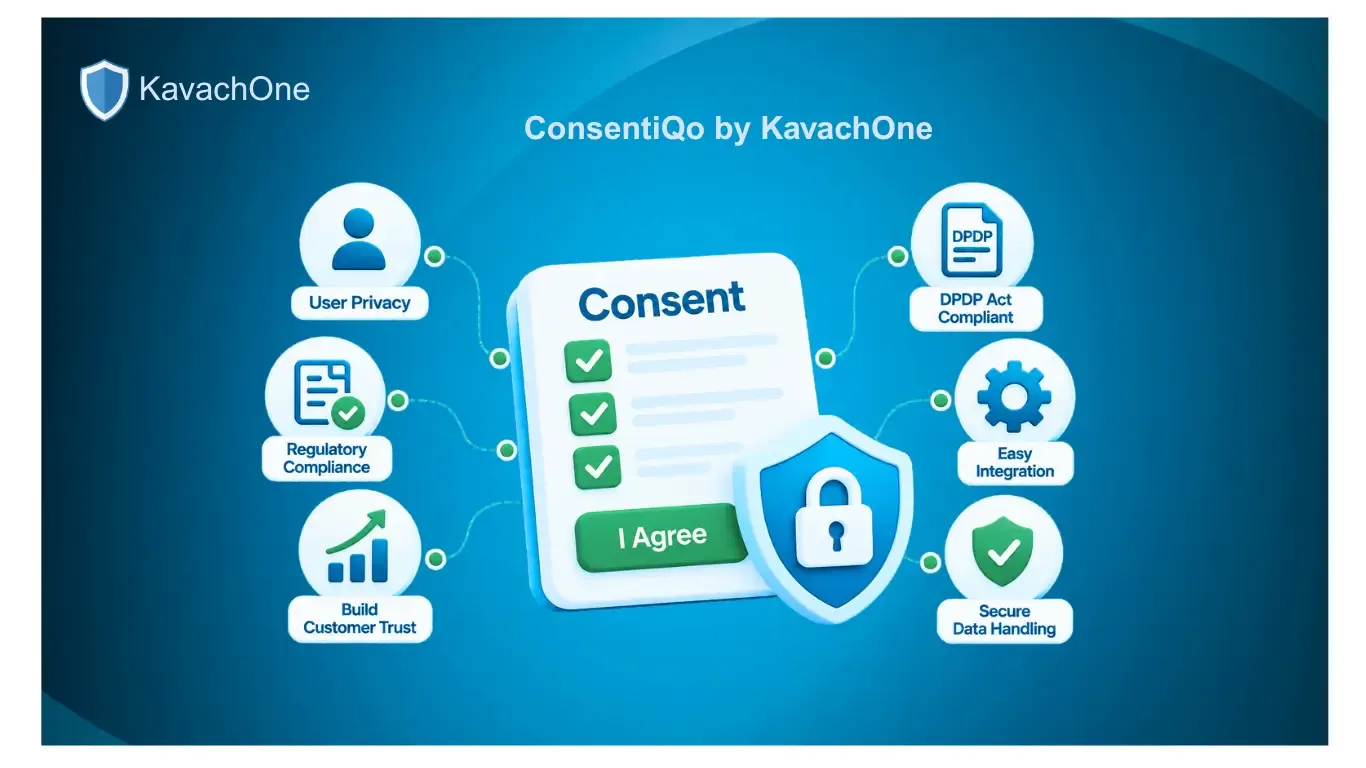
ConsentiQo forms the core of the platform and is a consent management tool specifically designed for India's diverse digital user base.
Native Multilingual UI: Dynamically displays compliant consent notices in English and all 22 official Indian languages across web apps, iOS, Android, and on-premise service kiosks.
Real-Time Revocation Sync: Built on a revocation-first event architecture, ConsentiQo triggers instant webhooks into CRMs, marketing automation software, and backend databases the moment a user withdraws consent.
Tamper-Evident Audit Trails: Log every consent interaction, amendment, and revocation in an immutable 7-year audit ledger, providing verifiable proof during regulatory reviews.
2. On-Premise PII Discovery with Zero Data Egress
Legacy discovery tools usually require moving sensitive database tables to third-party servers for indexing; KavachOne removes the risk of data leaks by carrying out the scanning within your own infrastructure:
Local Inspection: The scanner runs directly inside your Virtual Private Cloud (AWS, Azure, Google Cloud) or in an on-premises data center. Only discovery metadata reaches your reporting dashboard; your raw data never leaves its perimeter.
High-Accuracy Indian Identifiers: Deep-learning algorithms identify structured and unstructured PII—including Aadhaar cards, PAN numbers, voter IDs, passport data, and bank details—with over 99% accuracy.
Automated ROPA & DPIA: Continuously maps data lineage to generate real-time Records of Processing Activities (ROPA) and trigger dynamic Data Protection Impact Assessments (DPIA) when processing logic changes.
3. Automated DSAR and Grievance Management
Handling individual rights requests by hand can put a lot of pressure on technical teams. KavachOne offers a branded self-service portal that automates the entire DSAR process:
Identity Verification: Validates the Data Principal's identity to prevent the disclosure of fraudulent data.
Downstream Workflow Triggers: Automatically queries connected databases to package data summaries or execute secure erasure requests across production and backup systems.
Statutory Grievance Workflow: Features a built-in resolution dashboard with automated SLA timers, helping your team settle user disputes before they escalate to the Data Protection Board.
4. Third-Party Vendor Risk Management (TPRM)
To reduce risks from third-party processors, KavachOne brings all vendor security checks into one place:
Automated Risk Assessments: Screens external service providers and calculates dynamic vendor risk scores based on operational posture.
DPA Lifecycle Tracking: Tracks and archives enforceable Data Processing Agreements, ensuring every vendor processing customer data operates under valid legal coverage.
5. Techno-Audit Security Credentials & DPO-as-a-Service
Software by itself is not enough to prove compliance; you also need solid technical validation. KavachOne is a recognized PCI DSS Qualified Security Assessor (QSA) company, and its leaders hold top certifications like CISA, CISSP, CIPP, and CIPM:
Technical Security Hardening: Evaluates network perimeters, container configurations, and API security through rigorous Vulnerability Assessment and Penetration Testing (VAPT) to satisfy Section 8(5) requirements.
DPO-as-a-Service: For organizations needing experienced privacy leadership without hiring a full-time executive, KavachOne provides certified virtual Data Protection Officers to lead audits, supervise DPIAs, and interface directly with regulatory bodies.
Strategic Advantages: Turning Privacy into a Competitive Moat
If you see data privacy only as a way to avoid fines, you might miss its bigger business benefits. Working with KavachOne can help turn data management into a real advantage for your company:
Shorter B2B Sales Cycles: Enterprise buyers demand strict security and privacy validations from their software vendors. Demonstrating verifiable DPDP compliance and QSA-backed security assessments removes roadblocks during enterprise procurement reviews.
Increased Customer Lifetime Value: Providing clear, multilingual transparency and self-service control over personal data establishes deep consumer trust, increasing user retention and app store engagement.
Lower Cloud and Storage Costs: Automated PII scanning finds extra or outdated data. Removing these records reduces database costs and the risk of data breaches.
Cost Predictability: By working with a single partner rather than juggling legal fees, international software, and external security testers, you can keep your annual compliance costs steady.
Build Long-Term Privacy Governance with KavachOne
The days of handling data informally in India are over. The DPDP Act now requires organizations to show clear and proven control over every personal data record they manage.
Choosing KavachOne as your data privacy partner provides your organization with a comprehensive, enterprise-level solution. With features like multilingual consent collection, automated PII discovery, certified technical audits, and expert DPO advice, KavachOne helps keep your business protected, audit-ready, and set up for long-term digital growth.
Frequently Asked Questions (FAQs)
KavachOne Editorial Team
Cybersecurity & Compliance Experts