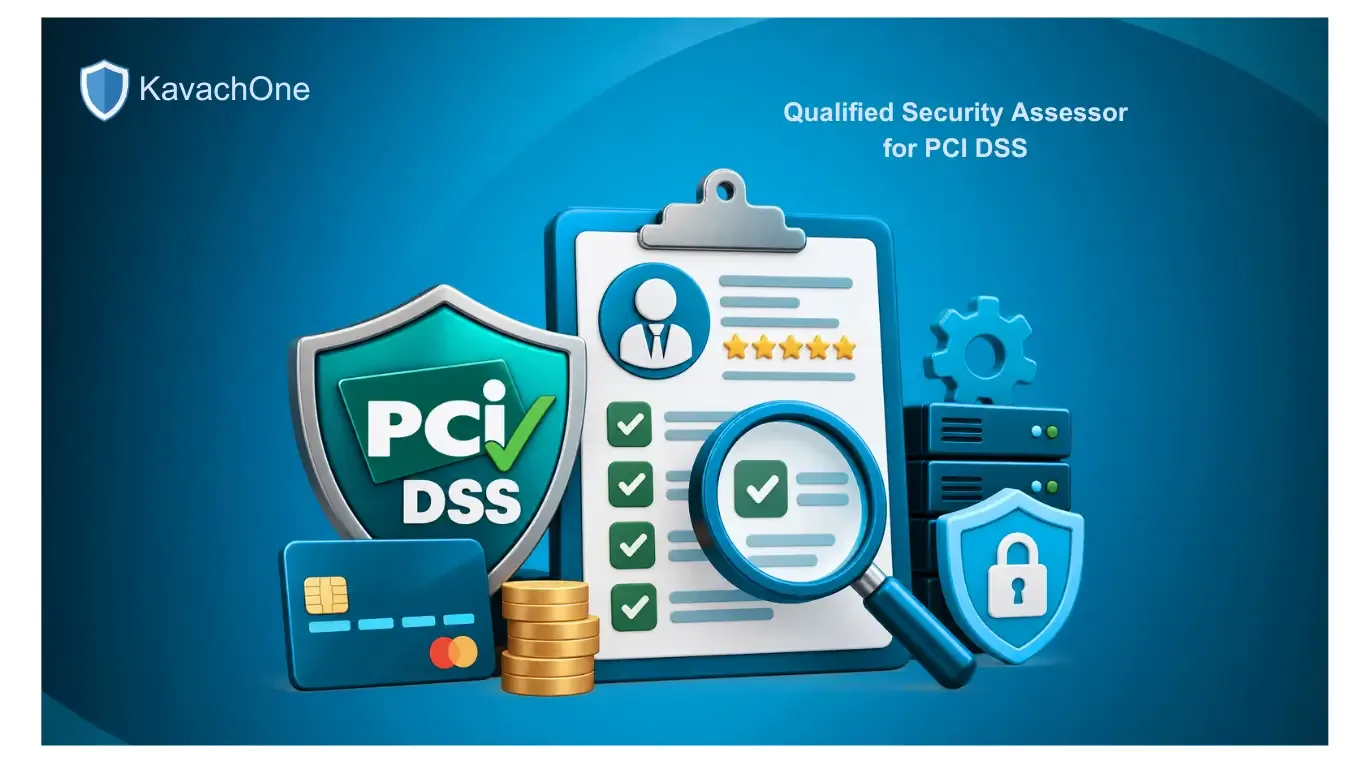

What is PCI DSS Certification?
PCI DSS (Payment Card Industry Data Security Standard) is an internationally accepted security model that was created to safeguard cardholder data in the course of storage, processing, and transmission.
If your business:
Accepts online payments
Authorizes credit cards/debit cards.
Stores customer card data
Then PCI DSS compliance is mandatory, not optional.
By using solutions such as KavachOne, companies can reduce the burden of complying with PCI DSS because they are able to manage all security controls, monitors, and audits through a single platform dashboard.
Importance of PCI DSS Certification in 2026
The emergence of digital payments and cyber threats is forcing the use of PCI DSS like never before.
Key Reasons:
Rising business attacks on payment systems.
Tougher regulations all over the world.
Increased customer needs for safe dealings.
Strict punishment for non-conformance.
In simple terms: PCI DSS = Security + Trust + Business Continuity.
PCI DSS Certification Levels Explained
There are 4 levels of businesses depending on the volume of transactions per year:
Level | Transactions per Year | Requirement |
Level 1 | Over 6 million | Full audit by QSA |
Level 2 | 1–6 million | SAQ + quarterly scans |
Level 3 | 20,000–1 million | SAQ |
Level 4 | Less than 20,000 | Basic compliance |
KavachOne will allow uninterrupted compliance by providing real-time monitoring, automatic alerts, and reportable audit-compliant to the requirements of PCI DSS 4.0.
PCI DSS 4.0 (Latest Version in 2026)
The most recent and fully implemented version is PCI DSS 4.0, which will be in force in 2026.
Key Updates:
Compulsory Multi-Factor Authentication (MFA).
Constant security surveillance.
Better encryption requirements.
Customized/flexible security controls.
Compliance is not a one-time project anymore; it is a continuous security process.
The process of PCI DSS Certification (step-by-step)
1. Define Scope
Determine cardholder data systems.
2. Perform Gap Analysis
Evaluate your current security posture.
3. Put in place Security Controls.
Firewalls
Encryption
Access control policies
4. Conduct Security Testing
Vulnerability scans (ASV)
Penetration testing
5. Audit & Documentation
Evaluation of a Qualified Security Assessor (QSA).
6. Certification
Get Attestation of Compliance (AOC).
Core Controls PCI DSS Certification 12 Requirements
PCI DSS consists of 12 core requirements of security:
Network Security
1. Install and Maintain Firewalls
Firewalls provide a barrier of the first line between your internal network and threats. They assist in filtering both incoming and outgoing traffic according to pre-existing security policies, whereby unauthorized users are not allowed to access any sensitive cardholder data environments.
2. Safe System Designs
The default system settings, e.g., passwords and settings, are usually publicly available and easy to exploit. The businesses need to make systems more difficult to attack by disabling services that are not needed, changing default credentials, and implementing secure configuration standards.
Data Protection
3. Secure Stored Cardholder Data
All data that was stored about cardholders needs to be secured with a high level of security, like encryption, masking, or tokenization. This guarantees that data cannot be misused or read in plain text, even in case it is accessed.
4. Encrypt Data Transmission
Any transactions carried out in an open or publicly accessible network should be encrypted with safe protocols such as TLS. This ensures that the attackers do not intercept any sensitive information during transmission.
Vulnerability Management
5. Anti-Virus and Malware Protection
Any systems should be safeguarded against malware using new antivirus programs. Scans and protection in real-time assist in detecting and averting malicious software that is likely to compromise sensitive information.
6. Be Secure System and Applications
One of the most frequent attack vectors is a security vulnerability in the software. Patching, updates, and secure coding practices should be carried out frequently in order to reduce the threat and secure the integrity of the system.
Access Control
7. Limit Access to Cardholder Information
Only authorized members should have access to sensitive data, depending on their job descriptions. This minimizes internal abuse or unintentional exposure to internal malicious code.
8. Give Individual IDs to All Users
All the people who access the system should be identified by unique identifiers. This makes it accountable and is used to monitor user activities when there is any suspicious or unauthorized user activity.
Monitoring & Testing
9. Limit the physical access to systems
Access to servers, databases, and network devices should be monitored and controlled physically. Physical intrusion may cause physical theft of data or a compromise.
10. Track and Monitor All Access
Any point of access to network resources and cardholder information should be tracked and logged. The benefits of continuous monitoring include early detection of suspicious activities and assistance during a forensic investigation.
11. Test Security Systems regularly
A regular vulnerability scan and penetration test should be performed by organizations to determine and address security vulnerabilities before the attacker can use them.
Security Policy
12. Hold an Information Security Policy
An effective security policy will make every employee aware of his/her contribution towards data security. It develops policies, duties and procedures of safeguarding the sensitive information.
Conclusion
Compliance is no longer a key point of PCI DSS Certification in 2026, but rather, the creation of a secure, scalable, and trusted payment ecosystem.
As the threats become more dynamic and the regulations are tightened, companies cannot afford to continue working without automation and considering more intelligent approaches.
That is where KavachOne comes in as the solution to making the PCI DSS compliance process less challenging, less risky, and faster to complete your certification.
Frequently Asked Questions (FAQs)
KavachOne Editorial Team
Cybersecurity & Compliance Experts