
Today’s organizations rely on a network of SaaS apps, cloud providers, logistics partners, and consultants. This setup speeds up business but also increases security risks. Your company’s cybersecurity is only as strong as its most vulnerable third-party vendor.
If just one contractor or third-party provider has a weakness, it can lead to data leaks, fines, and damage to your brand. Old methods like yearly spreadsheet audits are no longer enough. To keep your supply chain secure, you need a dedicated, automated, and ongoing vendor risk assessment tool.
Why Modern Enterprises Need a Dedicated Vendor Risk Assessment Tool
Managing third-party dependencies through manual spreadsheets, untracked emails, and disconnected PDF reports introduces systemic operational blind spots:
Questionnaire Staleness: An assessment completed via a static spreadsheet becomes outdated within hours of signing. A supplier's infrastructure, certificate validity periods, firewall configurations, and personnel are constantly changing.
Vendor Fatigue and Onboarding Delays: Procurement teams waste weeks chasing third-party security officers for evidence files, certifications, and questionnaire responses.
Lack of Data Context: Traditional methods treat all vendors identically. A local catering firm receives similar oversight to that of a cloud payroll provider processing sensitive Personally Identifiable Information (PII).
Unmonitored Fourth-Party Risk: Legacy audits overlook "shadow suppliers"—the sub-processors and cloud platforms that your vendors rely upon to host your corporate assets.
A top-tier vendor risk assessment platform replaces scattered manual processes with automated portals, standard frameworks, real-time risk tracking, and ongoing oversight.
Key Regulatory Frameworks Demanding Vendor Due Diligence
Worldwide regulatory authorities hold these primary organizations responsible for ensuring that their third-party processors do not mishandle data. Software used for managing vendor risk today enforces compliance continuously with the main standards:
1. Digital Personal Data Protection (DPDP) Act
Under the DPDP Act, organizations operating as Data Fiduciaries remain fully liable for breaches occurring on external Data Processor systems. Organizations must demonstrate contractual due diligence, maintain verified sub-processor registries, and ensure that active Data Processing Agreements (DPAs) are in place. Fines for third-party compliance failures reach up to ₹250 crore.
2. Outsourcing instructions from the Reserve Bank of India (RBI)
The RBI requires that financial institutions under its regulation implement strict information security measures with respect to their outsourced IT and cloud service providers. Financial organizations have to maintain continuous watch over risk, monitor their exposure to concentration risk, and ensure that there are clearly stated right-to-audit provisions.
3. International frameworks: ISO 27001, SOC 2, and NIST SP 800-161
The global cybersecurity standards set out strict requirements for supply chains. According to Control A.5.19 of ISO 27001:2022, organizations must carry out systematic information security management with respect to their suppliers. In the same way, the SOC 2 Trust Services Criteria require actual evidence that companies assess and mitigate third-party vulnerabilities on an ongoing basis.
Essential Features to Look for in a Vendor Risk Assessment Platform
When choosing vendor evaluation software, look for features that go beyond simple questionnaires:
1. Automated Vendor Profiling and Risk Tiering
Spreadsheets and manual forms treat all suppliers the same way, forcing security teams to categorize vendors using inconsistent criteria manually. A modern vendor risk assessment tool automatically tiers third parties based on data sensitivity, access levels, and business criticality. This ensures that high-risk vendors handling sensitive customer data face stringent evaluations, while low-risk suppliers follow lightweight, frictionless workflows.
2. AI-Assisted Evidence Parsing and Validation
Reviewing hundreds of pages of third-party audit reports—such as SOC 2 Type II packages, penetration test summaries, and ISO certificates—creates serious administrative bottlenecks. Nowadays, platforms use artificial intelligence to parse uploaded documents automatically, compare claimed controls with actual evidence, and immediately identify any gaps, missing security safeguards, or audit exceptions.
3. Continuous Monitoring Through Point-in-time Audits
Manual evaluation of vendors provides only a temporary view that quickly becomes outdated as third-party environments change. In contrast, the leading platforms offer continuous, real-time supervision by monitoring attack-surface telemetry, threat intelligence feeds, and certificate expirations, and they notify your team as soon as the vendor's security posture deteriorates.
4. Collaborative Remediation and Audit Workflows
Trying to fix security issues through scattered emails often leads to confusion and missed problems. A dedicated platform brings everything together with ticketing, action plans, communication logs, and automatic follow-ups, so everyone stays on track.
5. Mapping of the Dynamic Sub-Processor (a fourth party)
Manual spreadsheets seldom account for the subcontractors, cloud hosts, and software services your vendors use to process your data. In contrast, advanced vendor risk assessment software tracks downstream dependencies to identify fourth-party concentration risks and ensures you maintain full visibility across the entire digital supply chain.
KavachOne: The Top Vendor Risk Assessment Tool for Modern Organizations
KavachOne is a fully automated platform for Governance, Risk, and Compliance (GRC) and Third-Party Risk Management (TPRM), designed to eliminate the complexity of conducting vendor risk assessments. The platform links regional regulatory requirements, including the DPDP Act and RBI circulars, to international standards such as ISO 27001, SOC 2, HIPAA, and GDPR.
1. AI-powered vendor assessment without spreadsheets.
KavachOne takes over manual communication by providing an interactive portal for vendors. Instead of having to do it themselves, members of the risk team can send out questionnaires that are based on a framework (such as custom security standards, ISO requirements, and DPDP assessments) with just a few clicks. The AI system of KavachOne can analyze uploaded compliance documents (for example, 100-page SOC 2 Type II reports or ISO certificates) in seconds, identifying any missing multi-factor authentication (MFA), weak encryption standards, or compliance exceptions.
2. Built-In Regional and Global Compliance Mapping
Unlike legacy platforms that require months of manual configuration to meet non-Western regulatory requirements, KavachOne provides out-of-the-box templates mapped directly to the DPDP Act 2023, RBI IT Outsourcing guidelines, SEBI regulations, and international standards.
3. Dynamic Vendor Risk Scoring & Profiling
Different vendors do not have the same level of risk. KavachOne classifies its suppliers according to their business criticality, access privileges, and the types of data they process. Suppliers considered high risk and handling customers' personal information receive a thorough, automated examination, whereas those considered low risk receive a simplified verification process.
4. Continuous Monitoring & Fourth-Party Visibility
KavachOne moves security posture monitoring from a static exercise into an active defense mechanism. The platform continuously tracks vendor threat signals, flags posture degradations, monitors Data Processing Agreement (DPA) renewal cycles, and inventories sub-processors handling downstream personal data.
5. Unified GRC Ecosystem
Vendor risk management is most effective when it is incorporated into the wider corporate security strategy. KavachOne incorporates its TPRM directly into its main GRC Privacy suite. The risks discovered during vendor assessments are then synchronized directly with the enterprise's internal audit registers, its vulnerability management programs, and compliance frameworks such as SOC 2 and ISO 27001.
Business Benefits of Deploying KavachOne
Accelerated Vendor Onboarding: Reduces third-party onboarding time by up to 70% using automated intake portals, AI evidence analysis, and pre-built questionnaires.
Audit-Proof Compliance: Generates auditor-ready evidence logs, complete vendor risk profiles, and historical remediation timelines on demand.
Optimized Operational Resources: Enables small security and compliance teams to govern hundreds or thousands of external vendors without increasing administrative headcount.
Defensible Supply Chain Resilience: Identifies critical supplier vulnerabilities before they lead to public supply chain data breaches.
Step-by-Step: How to Conduct a Vendor Risk Assessment
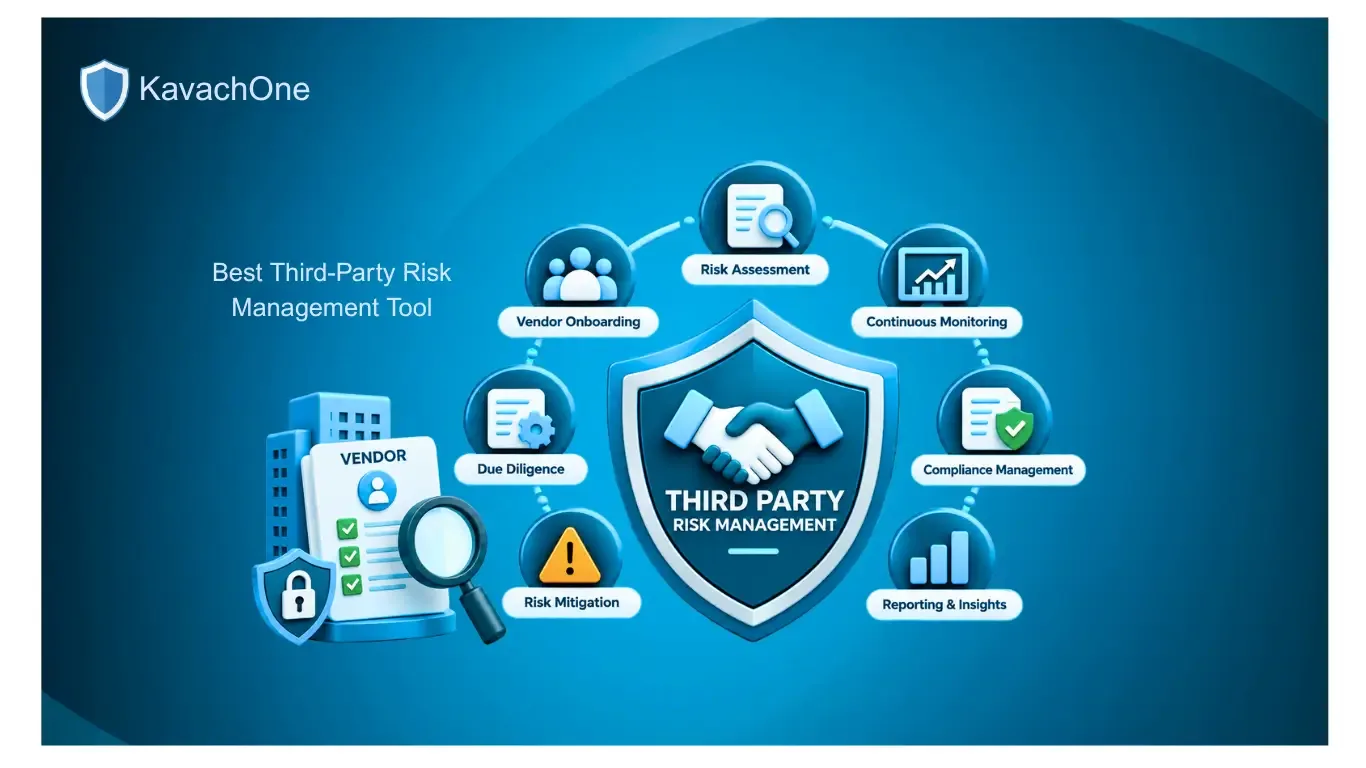
Vendor Inventory & Identification: Catalog all external vendors, contractors, and third-party SaaS tools across departments.
Contextual Risk Tiering: Score vendors based on data classification (e.g., PII, financial data, internal-only documentation) and network connectivity.
Automated Assessment Dispatch: Issue targeted assessment templates mapped to relevant regulatory mandates.
Evidence Analysis & Gap Identification: Validate certifications, review independent penetration testing reports, and flag deviations in controls.
Remediation & Contractual Controls: Assign corrective action plans with enforced resolution deadlines before finalizing procurement contracts.
Continuous Monitoring: Maintain ongoing oversight over contract renewals, sub-processor changes, and dynamic security posture fluctuations.
Ready to Eliminate Third-Party Vulnerabilities?
Stop wasting weeks chasing spreadsheets and manually reviewing audit PDFs. See how KavachOne automates vendor onboarding, maps out DPDP & global compliance, and monitors fourth-party risk in real time.
Frequently Asked Questions (FAQs)
KavachOne Editorial Team
Cybersecurity & Compliance Experts