
The passage of the Digital Personal Data Protection (DPDP) Act, 2023, is a watershed moment for financial institutions in India regarding how they manage customer data. The scheduled commercial banks have had years to build up their automated data security programs. The UCBs are in a very different position. They operate in a hybrid physical/digital environment with legacy Core Banking Solutions and very local customer bases and are therefore facing a very different compliance challenge.
Achieving DPDP compliance for the Urban Cooperative Banks in India is no longer just a tick-box exercise. It's a statutory requirement with penalties of up to ₹250 crore for security failures and up to ₹200 crore for reporting failures.
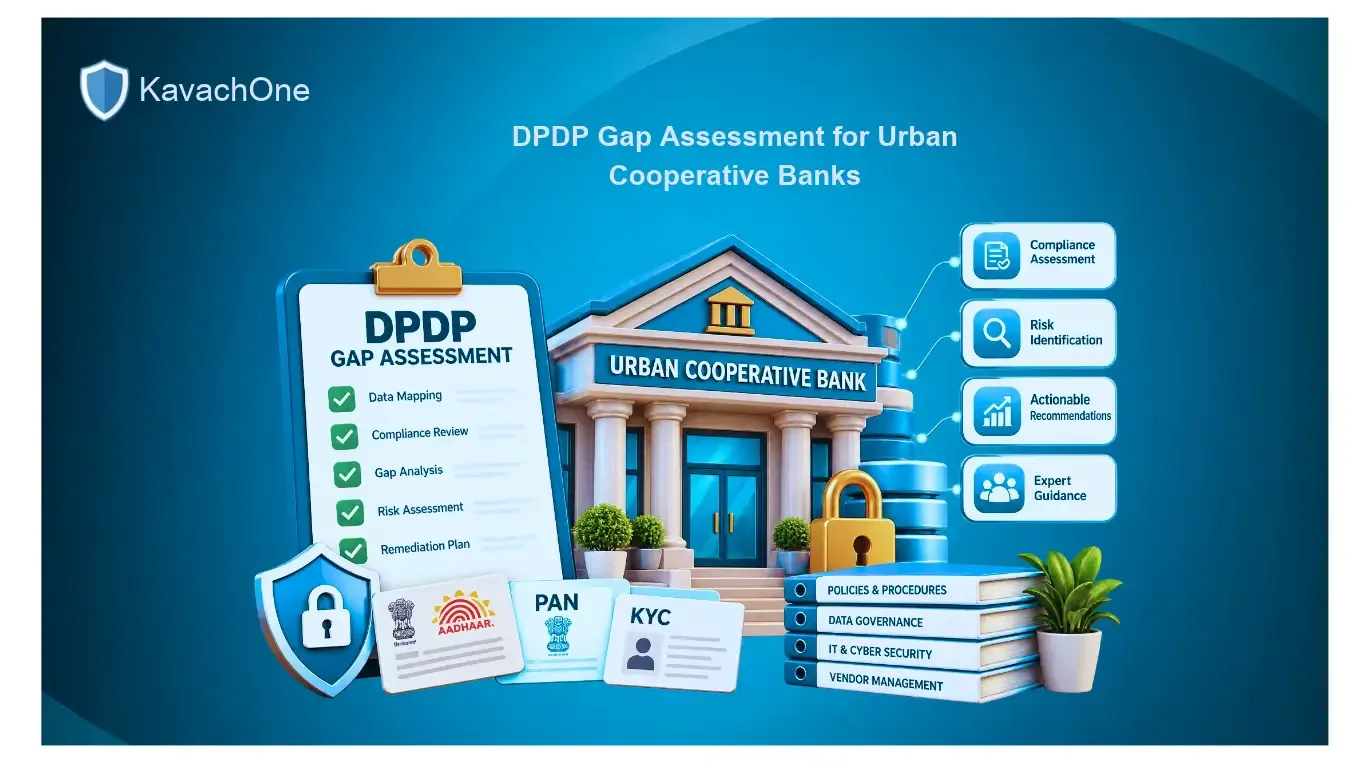
This guide explains DPDP compliance for Urban Cooperative Banks in India, including key requirements, implementation challenges, practical steps for compliance, and how KavachOne can help banks strengthen their data protection practices.
Understanding the DPDP Act in the Banking Context
Under the DPDP framework:
Data Principal: The individual whose personal data is collected (e.g., account holders, loan applicants, depositors, guarantors, or staff).
Data Fiduciary: The entity that determines the purpose and means of the data processing (in this case, your Urban Cooperative Bank).
Data Processor: Any external service vendor processing customer information on your bank's behalf (e.g., third-party CBS hosts, switch processors, outsourced recovery agents, digital KYC vendors, and SMS gateway providers).
The law requires that any processing of personal data must be based either on verifiable, specific consent or on one of the recognized legitimate grounds (e.g., compliance with the RBI's requirements).
Key DPDP Compliance Requirements for Urban Cooperative Banks
1. Multilingual Notice and Consent (Sections 5 & 6)
UCBs often serve local, regional communities where customers transact in regional vernaculars.
Granular Notice: Before seeking consent for customer onboarding, loan sanctions, or mobile app registration, banks must present an itemized notice explaining exactly what data is collected and for what specific purpose.
Eighth Schedule Languages: Notices must be accessible in English and any of the 22 languages recognized under the Eighth Schedule to the Constitution of India.
Unbundled Consent: A loan agreement or account-opening form cannot bundle promotional messaging, third-party insurance cross-selling, or analytics into a single blanket signature.
2. Reconciliation of DPDP with RBI Mandates (Section 8)
Data retention is a key concern for cooperative bankers. The DPDP Act gives Data Principals the right to have their data erased, but Section 8 makes it clear that existing legal requirements still apply:
Prevention of Money Laundering Act (PMLA) & RBI KYC Directions:
Banks are legally required to retain transaction histories and customer identity documents for at least
5 to 10 years after an account is closed.
Harmonized Erasure: If a customer requests deletion of their KYC record, the bank must keep only the records required by law. Non-essential data, such as behavioral logs, marketing lists, or extra application forms, should be deleted.
3. Fulfilling Data Principal Rights (Sections 11–14)
Urban Cooperative Banks must operationalize formal Subject Access Request (SAR) workflows allowing customers to:
Access summaries of personal data processed and identities of shared third parties.
Seek correction, completion, or updating of inaccurate records (e.g., outdated address or misspelled names).
Withdraw consent previously granted for optional value-added services.
Nominate an alternate individual to exercise privacy rights in the event of death or incapacity.
4. Third-Party Vendor Risk Management (TPRM)
Most Tier-1 and Tier-2 UCBs use third-party technology providers for core banking software, cloud storage, payment gateways, and debit card services.
Under Section 8, the bank retains primary liability for processor non-compliance.
UCBs need to sign Data Processing Agreements (DPAs) with their technical vendors. These agreements should ensure that data stays within India, complies with I rules, and that strong security measures are in place.
5. Mandatory Breach Reporting (Within 72 Hours)
In the event of a personal data leak or ransomware incident, UCBs cannot simply contain it internally. The DPDP Act requires immediate notification to both:
Affected Data Principals (customers).
The Data Protection Board of India (DPBI) within 72 hours.
Common Compliance Roadblocks Faced by UCBs
Challenge Area | Urban Cooperative Bank Reality | DPDP Act Requirement |
Legacy CBS Systems | Data spread across legacy relational databases, flat files, and decentralized branch servers. | Continuous data lineage and structured Records of Processing Activities (RoPA). |
Physical Paper Trails | Hard-copy loan dockets, physical KYC xeroxes, and physical ledger books stored in branch vaults. | Digitized data mapping, access logs, and strict retention/shredding schedules. |
Consent Logging | Blanket consent checkboxes embedded inside physical 6-page account forms. | Granular, timestamped, unbundled consent logs with real-time revocation support. |
Internal Skill Sets | Lean internal IT units with limited dedicated privacy or cyber-legal staff. | Accountable privacy governance, internal data auditors, and DPO supervision. |
How KavachOne Empowers Urban Cooperative Banks with End-to-End Compliance
You do not need to rebuild your entire banking system to meet regulatory requirements. KavachOne provides cybersecurity, privacy consulting, and governance services designed to help Indian financial institutions fully comply with the DPDP Act and RBI guidelines.
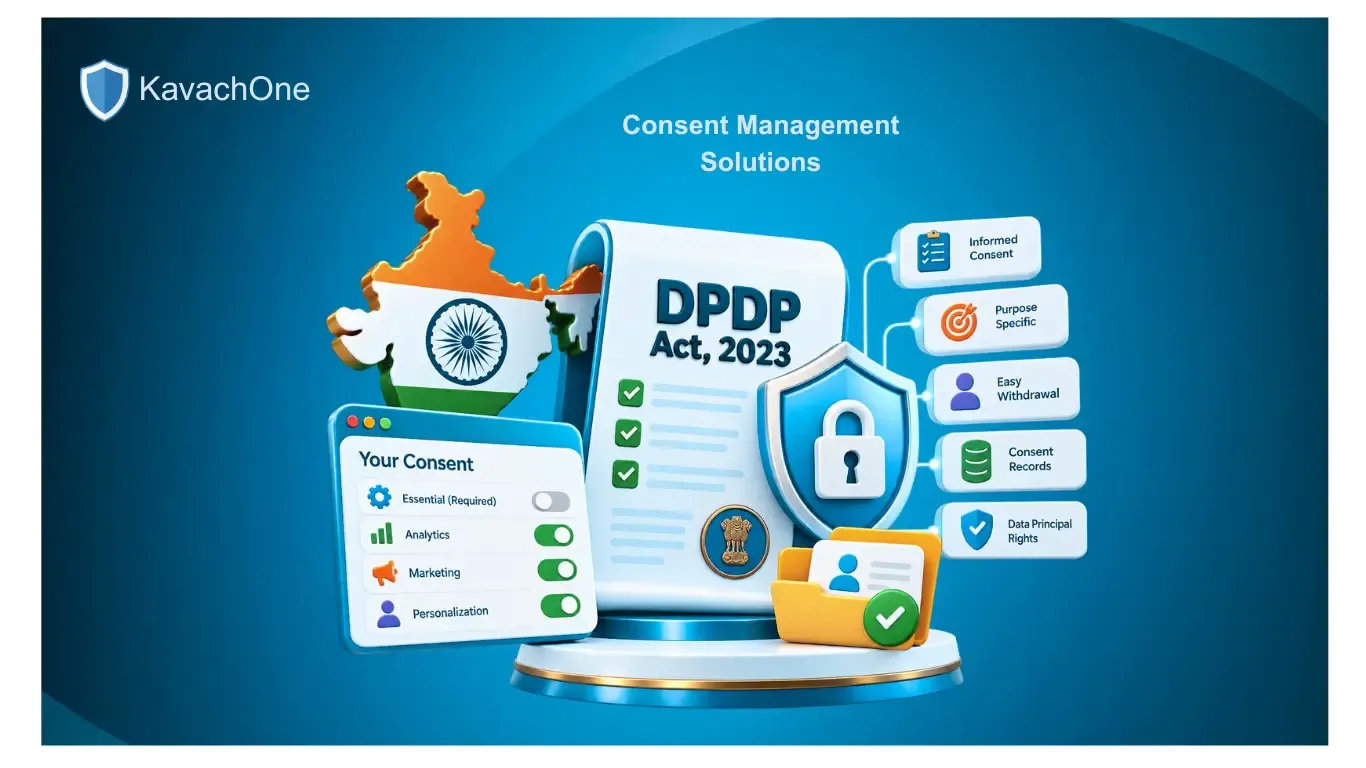
ConsentiQo: Multilingual Consent & Notice Engine
22 Scheduled Languages: Deploys dynamic, itemized privacy notices across online customer portals, branch kiosks, and digital loan onboarding workflows in regional languages.
Revocation Sync: When a customer withdraws consent, this feature automatically updates CBS modules and stops marketing calls or non-essential data processing right away.
Tamper-Evident Logs: Creates immutable, audit-ready consent trails to prove compliance during regulatory reviews.
On-Premises PII Discovery (Zero Data Egress)
Local Perimeter Scanning: Rather than risking data security by sending sensitive account information to external servers, KavachOne scans for customer PII (Aadhaar, PAN, account numbers, land deeds) directly inside your bank’s on-premises data center or private cloud.
Deep-Learning Identifiers: This tool automatically sorts both structured and unstructured Indian financial identifiers with over 99% accuracy.
Automated RoPA: Generates clear Records of Processing Activities (RoPA) and highlights unmanaged data repositories.
Automated Data Principal Rights & Grievance Redressal
Self-Service Citizen Portal: This secure portal lets cooperative bank members submit requests to correct, update, or access their information.
SLA Timers: Track statutory turnaround times to ensure disputes and requests are resolved efficiently and to avoid escalation to the DPBI.
Techno-Audit Capabilities & DPO-as-a-Service
Section 8(5) Technical Hardening: As a qualified security assessment entity, KavachOne conducts in-depth Vulnerability Assessment and Penetration Testing (VAPT) across core banking APIs, web portals, and mobile banking apps.
Virtual Data Protection Officer: For UCBs that cannot justify a full-time, high-cost executive privacy officer, KavachOne’s DPO-as-a-Service provides certified privacy leaders to impact assessments, manage regulator correspondence, and supervise annual audits.
5-Step DPDP Implementation Roadmap for UCB Leadership
Perform a Privacy Gap Assessment: Compare your current branch processes, online banking portals, and CBS data flows with the DPDP Act and draft rules.
Catalog Personal Data: Identify every database, Excel workbook, backup tape, and branch archive that contains member records.
Overhaul Consent Forms & Notices: Replace bundled checkboxes on customer forms for clear, separate notices in the local languages your customers use.
Enforce Vendor Safeguards: Review your third-party service providers, sign Data Processing Agreements (DPAs), and make sure no customer financial data is stored outside India.
Establish Incident Response Protocols: Develop a formalized 72-hour breach-reporting matrix that involves IT, legal, and board-level risk management committees.
Strengthen Your Bank’s Privacy Posture
Implementing DPDP compliance for Urban Cooperative Banks in India is essential to safeguarding your institution against severe penalties while cementing depositor confidence. With native support for 22 scheduled languages, local PII scanning, and end-to-end audit readiness, modern compliance platforms remove operational overhead and ensure seamless compliance with both RBI and DPBI expectations.
Contact KavachOne today to assess your DPDP readiness and strengthen customer data protection.
Frequently Asked Questions (FAQs)
KavachOne Editorial Team
Cybersecurity & Compliance Experts