
The rapid growth of generative AI has made startups move faster than ever. Now, even early-stage AI startups are pitching Fortune 500 companies, offering new ways to automate work, predict outcomes, and use custom language models.
But when it comes to selling to large companies, founders often run into a common problem: the vendor security assessment.
When prospective enterprise clients ask, "Can we see your SOC 2 report?", presenting a point-in-time self-assessment is rarely enough. For companies handling sensitive corporate data, intellectual property, or personally identifiable information (PII) within dynamic machine learning pipelines, obtaining a SOC 2 Type 2 Compliance Certification for AI Startups has transformed from a "nice-to-have" badge into an indispensable revenue driver.
In this guide, we explain SOC 2 Type 2 requirements for AI startups, the audit process, common challenges, and how KavachOne can help organizations prepare for compliance.
What is SOC 2 Type 2 Compliance, and Why Is It Unique for AI Startups?
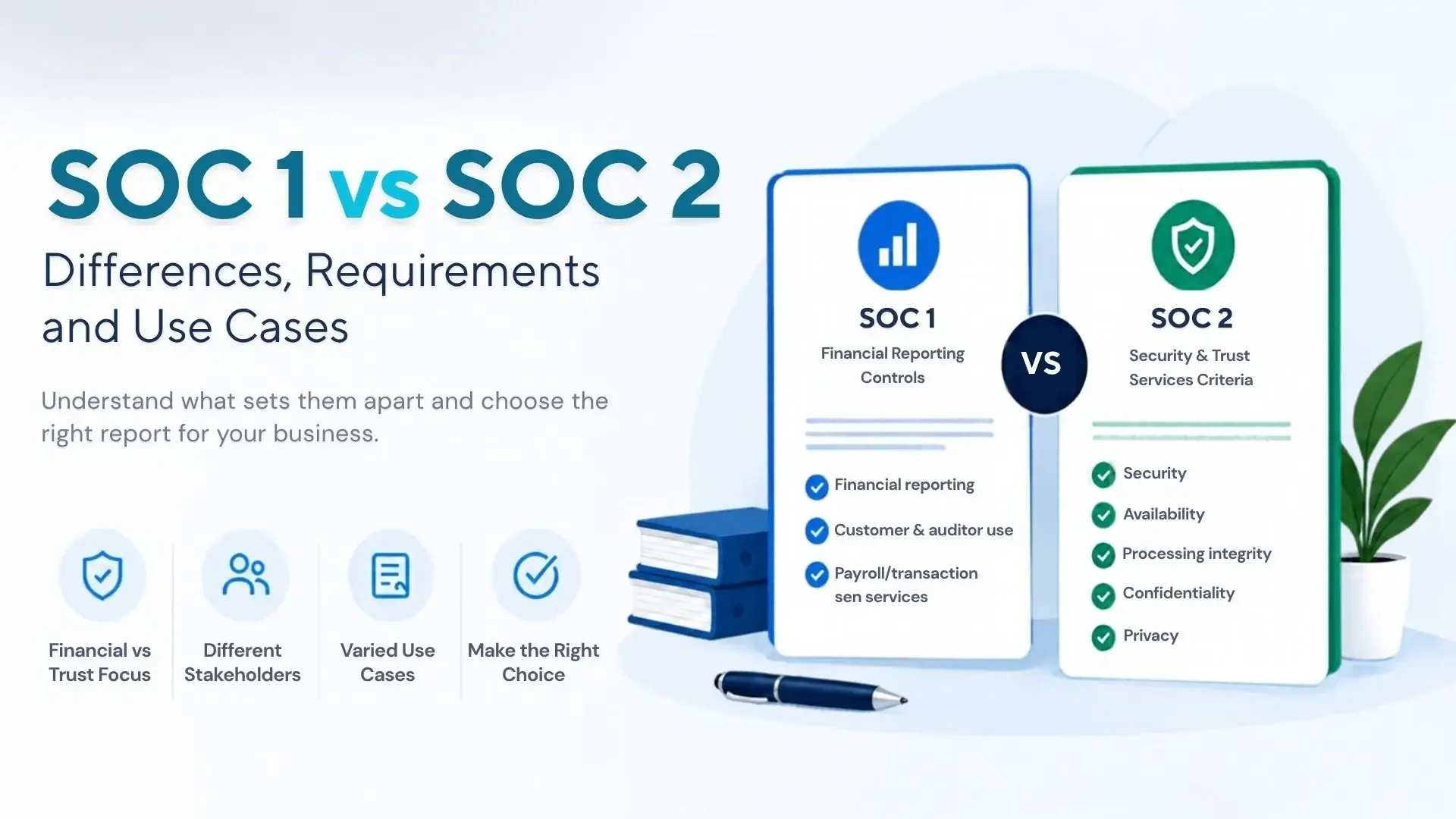
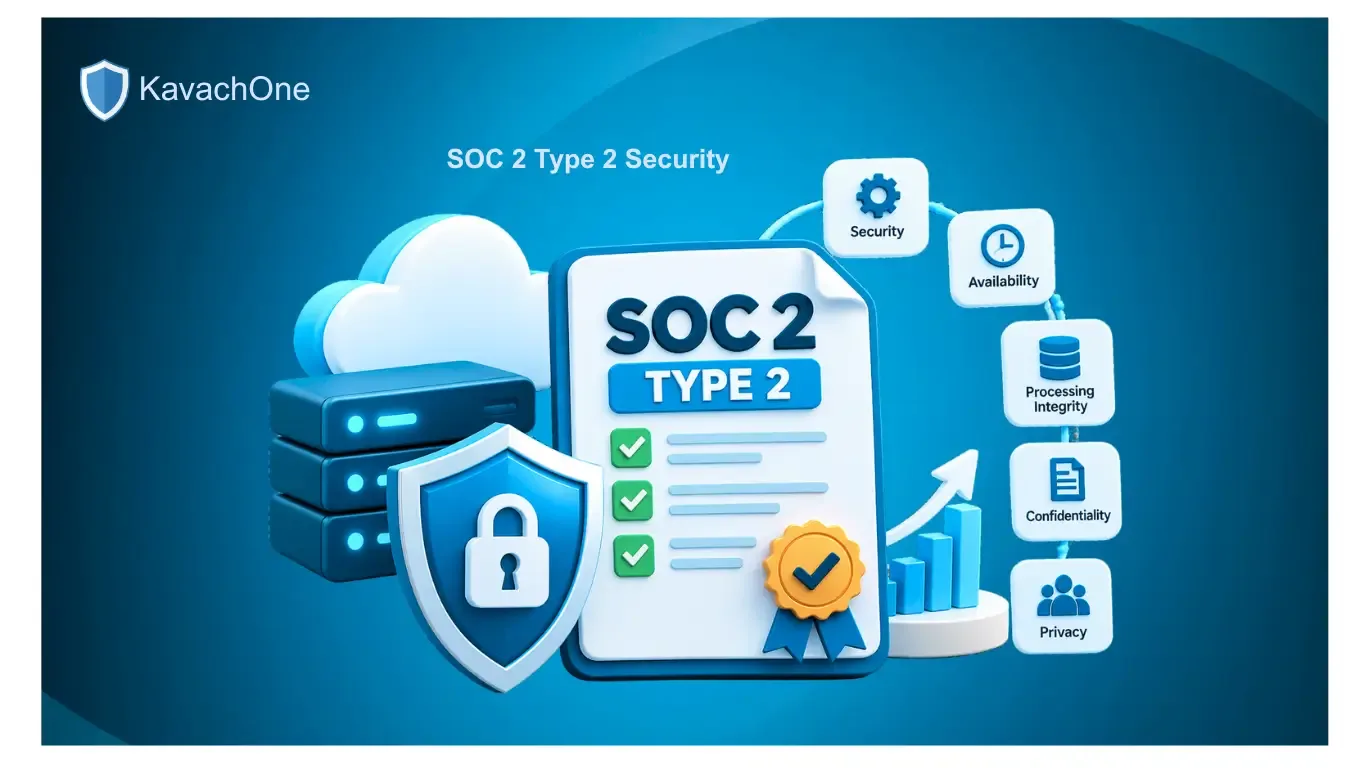
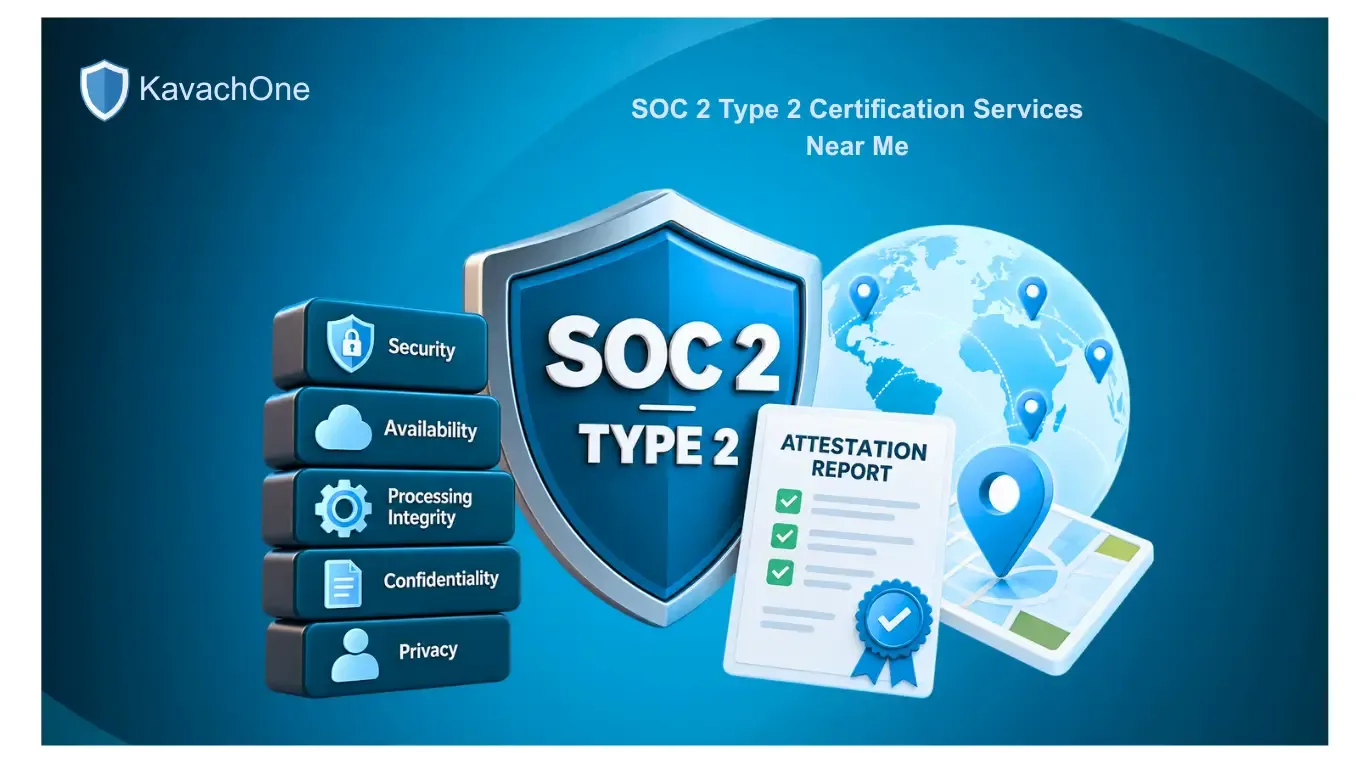
Developed by the American Institute of Certified Public Accountants (AICPA), a System and Organization Controls (SOC) 2 report evaluates how well a cloud organization protects customer data based on five Trust Services Criteria (TSC):
Security (Common Criteria): Protection against unauthorized access and system compromise.
Availability: Reliability and operational accessibility of products and infrastructure.
Processing Integrity: Complete, valid, accurate, timely, and authorized system processing.
Confidentiality: Safeguarding confidential business information and model artifacts.
Privacy: Conscientious handling, storage, and disposal of personal data.
SOC 2 Type 1 vs. SOC 2 Type 2
SOC 2 Type 1 assesses whether your security controls are properly designed at a single point in time.
SOC 2 Type 2 evaluates whether those security controls operate effectively over an extended observation period (typically 3 to 12 months).
The AI Dilemma: Why Traditional Audits Fall Short
Traditional SaaS architectures feature relatively static data flows: user inputs data, data is stored in relational databases, and data is rendered on a dashboard.
AI-native platforms operate entirely differently:
Training data provenance: Training datasets and embedding ingestion pipelines are routinely processing unstructured user data.
Third-party model APIs and cloud inference: workflows will typically rely on foundational model providers (OpenAI, Anthropic, AWS Bedrock, etc.), thereby increasing third-party vendor risk.
Vector Databases & RAG Architectures: Dynamic Retrieval-Augmented Generation (RAG) pipelines cache unstructured context and proprietary customer documents, raising critical data isolation questions.
Non-Deterministic Outputs: Unlike predictable CRUD applications, LLM outputs require stringent guardrails to prevent data leakage, prompt injection, and hallucinations.
For enterprise customers, a SOC 2 Type 2 certification shows that your AI systems, data pipelines, and controls always protect data privacy and keep infrastructure secure.
Practical Compliance Requirements for AI Companies
Achieving a clean SOC 2 Type 2 attestation requires translating abstract AICPA controls into your modern AI stack. Below are key technical and operational requirements AI startups must implement.
1. Data Governance and RAG Pipeline Isolation
Zero Data Retention (ZDR) Guarantees: Enterprise customers demand assurances that their data will not be used to train foundational or public models. You must maintain audit logs proving tenant data isolation.
Embedding & Vector Security: Multi-tenant vector databases (e.g., Pinecone, Qdrant, Milvus) must enforce role-based access control (RBAC) and tenant partitioning at the metadata level to prevent cross-tenant data leakage.
Encryption everywhere: Data must be encrypted at rest using AES-256 and in transit via TLS 1.3 across all embedding pipelines, object storage (S3/GCS buckets), and cache layers.
2. CI/CD, Model Versioning, and Code Integrity
Traceable Deployments: Model weights, prompt templates, and application code must all be version-controlled, peer-reviewed, and deployed via automated CI/CD pipelines.
Static & Dynamic Analysis: Automated vulnerability scanning (SAST/DAST) must inspect application dependencies and open-source packages before any production build.
Incident Response for AI Failures: Documented remediation procedures must address adversarial inputs, jailbreaks, and prompt-extraction attempts.
3. Identity and Access Management (IAM)
Principle of Least Privilege (PoLP): Engineers should not have persistent unmonitored access to production databases or raw data.
Mandatory Multi-Factor Authentication (MFA): Enforce MFA via hardware token or authenticator (e.g., Google Authenticator) across all code repositories (GitHub/GitLab), all cloud consoles (AWS/GCP/Azure), and all identity providers.
Automated Offboarding: Revocation of employee credentials within 24 hours of departure.
4. Vendor Risk Management (VRM) for AI Dependencies
When your startup integrates external AI APIs or GPU cloud providers (e.g., Lambda Labs, RunPod), your audit scope extends to them. You must collect and review:
Up-to-date SOC 2 Type 2 reports and ISO 27001 certificates of all upstream providers.
Formal Data Processing Agreements (DPAs) stipulating zero-training commitments.
Step-by-Step Roadmap to Achieving SOC 2 Type 2
Navigating your first audit does not have to stall your product roadmap. Here is an actionable 5-step roadmap:
Phase 1: Readiness & Scoping
Define your system boundary (cloud infrastructure, codebases, vector stores, and administrative tools).
Select your relevant Trust Services Criteria. (Start with Security; add Confidentiality and Availability if processing proprietary enterprise documents).
Phase 2: Gap Assessment and Remediation
Perform an automated gap analysis across your cloud environments.
Write core security policies (Information Security Policy, Business Continuity, Access Management, AI Governance Policy).
Implement mobile device management (MDM) on all employee workstations.
Phase 3: SOC 2 Type 1 Audit
Undergo a point-in-time assessment to validate control design. This provides immediate proof of security for enterprise prospects while the Type 2 clock runs.
Phase 4: The Observation Window (3–6 Months)
Maintain operational discipline. Ensure every new hire completes background checks and security training, that every code change is approved, and that periodic access reviews occur on schedule.
Phase 5: Final Audit and Report Issuance
An independent CPA firm examines logged evidence across the audit window.
The auditor delivers the final SOC 2 Type 2 attestation report.
Accelerating Audit Readiness with KavachOne
For early-stage teams, handling compliance manually with spreadsheets, screenshots, and scattered policy templates can take over 300 engineering hours. KavachOne removes this hassle with an automated, developer-focused platform built for fast-growing tech companies and AI startups.
Key Features of KavachOne
Automated Cloud Evidence Collection: Connects natively with AWS, Google Cloud, Azure, GitHub, and identity providers to continuously sample configurations and collect tamper-proof evidence without manual screenshots.
Pre-Built AI Governance Templates: Provides audit-approved policies tailored specifically for AI companies, including LLM data handling, training data lifecycle management, and prompt engineering security controls.
Real-Time Vulnerability & Drift Detection: Notifies your team immediately if an S3 bucket becomes public, an engineer disables MFA, or an unreviewed pull request bypasses branch protection.
End-to-End Auditor Collaboration: KavachOne pairs you with vetted, tech-native CPA auditing firms who work directly inside the platform's auditor portal, cutting report turnaround time from months to weeks.
Tangible Benefits for AI Startups
Benefit | Manual Approach | With KavachOne |
Time to Audit-Readiness | 6–9 months | 2–4 weeks |
Engineering Hours Spent | 250–400 hours | < 25 hours |
Evidence Collection | Manual screenshots & spreadsheets | Automated, 24/7 background sync |
Enterprise Sales Velocity | Stalled in security reviews | Fast-tracked vendor approvals |
Business Value: How SOC 2 Type 2 Unlocks Enterprise Growth
Shortens Enterprise Sales Cycles: Eliminates lengthy 100-question security spreadsheets. Providing a clean SOC 2 Type 2 report lets enterprise InfoSec teams approve vendor onboarding in days rather than months.
Commands Higher Contract Values: Tier-1 enterprise clients only sign five- and six-figure ACV deals with vendors that can demonstrate continuous risk mitigation.
Defensible Competitive Advantage: In crowded generative AI niches, being the first SOC 2 Type 2 compliant vendor immediately differentiates you from unfunded wrapper tools and casual hobbyist projects.
Investor Confidence: Institutional venture capital firms prioritize security posture during Series A and B technical due diligence.
Conclusion: Turn Security into Your Growth Engine
In the competitive artificial intelligence landscape, speed to market matters—but customer trust closes enterprise deals. Waiting until a seven-figure contract stalls in legal or compliance review can set your business back months.
Prioritizing your SOC 2 Type 2 Compliance Certification for AI Startups demonstrates to clients, partners, and investors that your cutting-edge product is backed by mature, enterprise-grade data governance.
Ready to streamline your compliance journey without slowing down engineering? Explore KavachOne today to automate evidence collection, enforce continuous AI security controls, and fast-track your SOC 2 Type 2 certification.
Frequently Asked Questions (FAQs)
KavachOne Editorial Team
Cybersecurity & Compliance Experts